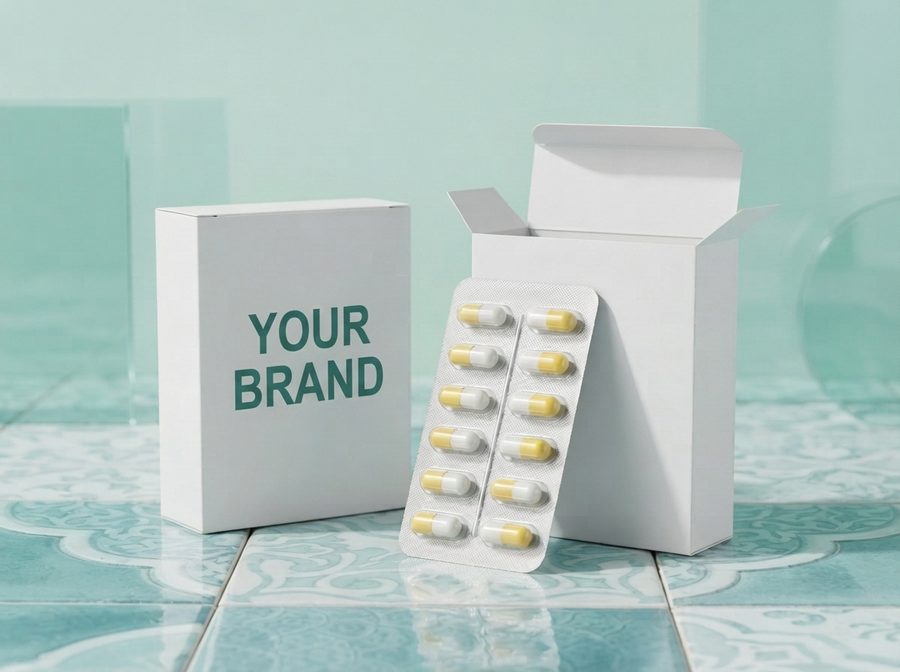
In Tunisia your importer or another local applicant files with the Tunisian authority that handles your product, and your importer confirms which one. HYPERPHARM supplies the manufacturer's side of the file: the Certificate of Analysis and specification, copies of the plant's certificates, the Certificate of Free Sale, the Certificate of Manufacture, and the apostille where Tunisia asks for a certified document. Buyers in Tunisia read French and Arabic, so the carton and the label are laid out in French or Arabic, as your importer confirms.
In one line: supplements for Tunisia under your brand, from 100 units in stock packaging and from 2 weeks, with the carton in French or Arabic. Blisters start from 2,000 cartons, with the documents your importer files. Send the product and the quantity through contact us; we answer within 24 hours, Monday to Friday.
| Question | Tunisia | Source |
|---|---|---|
| Specific supplements law | None yet; the parliament's health committee heard manufacturers on a proposed law in March 2026 | AllAfrica (French edition), 12 March 2026 |
| Pharmacists | In May 2026 the pharmacists' union asked for health ministry control of food supplements | La Presse de Tunisie, 9 May 2026 |
| Authority | Your importer confirms which Tunisian authority handles your product | HYPERPHARM order terms |
| Who files | Your importer or another local applicant, with the manufacturer's documents | HYPERPHARM order terms |
| Label language | Your importer confirms it for your product; HYPERPHARM lays out the carton in French or Arabic | HYPERPHARM order terms |
| Apostille | Tunisia is a party to the Apostille Convention, since 30 March 2018 | HCCH status table, update of 30 June 2026 |
| WHO long-term condition | 25 °C/60% RH, zone II; a reference for a supplement, as WHO's list is written for medicines | WHO stability list, March 2021 |
| Documents from the plant | Certificate of Analysis, specification, Certificate of Free Sale and Certificate of Manufacture; copies of the plant's certificates | HYPERPHARM |
Is there a European supplement manufacturer that makes private label products for Tunisia?
Yes. HYPERPHARM makes white label products from more than 500 ready-made formulas, with new ones added every month, and private label products to your own formula. It ships to more than 60 countries, and the team answers in English, French, Arabic and Russian.
Tablets, capsules and softgels can be sealed in blisters with a printed carton, or packed in bottles, tubes, pouches and sachets, and a sample goes out before an order. See white label supplements and private label supplements.
What is the minimum order and lead time for supplements for Tunisia?
The smallest start is a ready-made formula in stock packaging: from 100 units, with production from 2 weeks. A formula of your own starts from 500 bottles per product, with production from 4 weeks. Powders, sachets and sports nutrition start from 300 kg. Full figures by format are on the minimum order page and the lead times page.
A blister run starts from 2,000 cartons and at least 4,000 blisters, with a ready-made formula or your own, and production takes from 2 weeks. Each carton holds 1 to 4 blisters, one kind of tablet or capsule per blister, and the lidding foil is printed with your brand. The same minimum applies to a repeat order. Delivery is worldwide, EXW by default, FCA or DAP on request; transport time comes on top of production.
A first shipment to Tunisia can combine several ready-made formulas in stock packaging; choose them from the ready-made formulas, and see for distributors for an importer's range.
How do I bring a food supplement into Tunisia, and who files?
Your importer or another local applicant files; the approval is the Tunisian authority's decision. Tunisia has no law written specifically for food supplements yet. In March 2026 the parliament's health committee heard manufacturers on a proposed law, and in May 2026 the pharmacists' union asked for health ministry control of supplements, according to the Tunisian press. Your importer therefore confirms the route for your product: which authority takes the file, and what the file lists.
Before the first order, ask your importer for three things in writing: the authority that handles your product, the list of documents for the file, and the label text. HYPERPHARM uses the answers to request the documents together with the batch and to prepare the artwork.
Which documents can the manufacturer supply for a Tunisian file?
Next to each item is what HYPERPHARM supplies. Your importer confirms which of them the Tunisian file asks for.
- Certificate of Analysis and specification. They come with every batch, and go into the file with your importer's other papers.
- Certificate of Free Sale and Certificate of Manufacture. HYPERPHARM arranges both when your importer's file needs them. See export documents.
- Apostille and legalisation. Tunisia is a party to the Apostille Convention, so an apostille is possible, and HYPERPHARM arranges it where Tunisia asks for a certified document. Consular legalisation is arranged as well where the country of sale asks for it.
- Site certificates. Copies of the plant's ISO 22000, GMP and HACCP certificates go out on request, with their numbers. The certificates are issued by BM Certification: ISO 22000:2018 is valid to 7 January 2029, and HACCP and GMP for food supplements to 17 May 2027. The plant is also registered with the US Food and Drug Administration as a food facility (quality).
- Leaflet. A printed leaflet goes into the carton, to your artwork.
- Samples and a plant visit. A sample goes out before an order, and a visit to the plant can be arranged.
What language should a supplement carton for Tunisia carry?
Your importer confirms the language for your product, and buyers in Tunisia read French and Arabic. HYPERPHARM lays out and prints the carton, the label and the leaflet in French or Arabic, or in both, to the text your importer gives, or prints from your own artwork. See Arabic and French packaging.
The batch number, production date and expiry date are printed on the carton, or applied as the blisters are cartoned, and standard shelf life is 24 months. If your importer asks for a registration number or the importer's name and address on the pack, the layout leaves room for them, and the final artwork is approved once your importer gives them. Send the layout for approval before print.
Does Tunisia accept an apostille on export documents?
Yes. Tunisia has been a party to the Apostille Convention since 30 March 2018, according to the HCCH status table of 30 June 2026. Between two parties an apostille holds unless one of them objected to the other's accession, and the table records objections to Tunisia's accession, so your importer confirms the route for the documents that go into your file.
Ask your importer for the current list before you order, so the certificates and the apostille are requested together with the batch.
Can I order now, while Tunisia's supplement law is being prepared?
Yes. A formula, a format and a carton can be prepared in parallel with your importer's enquiry to the authority, so the first order does not wait for a new law. A sample and a quote come first, and the artwork is approved before print.
Settle the label text with your importer before the carton goes to print, because rules that are being prepared can change between artwork and arrival. A first run in stock packaging, from 100 units, lets you test the market while the file moves.
Do blisters suit Tunisia's climate?
WHO's list gives Tunisia a long-term condition of 25 °C/60% RH, zone II. In a blister each dose stays sealed in its own cavity until it is pushed out, and how much moisture reaches it depends on the film: PVC, PVC/PVDC and cold-formed aluminium (alu-alu) are offered as options for your product, and the film is confirmed in our reply.
The WHO list is written for medicines, so for a supplement it is a reference; your importer confirms what the Tunisian authority accepts. See climatic zones by country and shelf life and storage.
Can one product serve Tunisia, Morocco and Egypt?
Yes, with a carton for each market. Egypt asks for Arabic and English on the outer and the inner pack for a product the Egyptian Drug Authority registers, Morocco puts the registration number and the importer's name and address on the imported pack, and Tunisia's language is the one your importer confirms. Plan one artwork for each country, approved one by one, and a document route for each.
The documents differ too. Tunisia and Morocco are parties to the Apostille Convention, and Egypt is not, so an Egyptian file goes through an embassy or consulate. WHO's list gives Egypt 30 °C/65% RH and Tunisia and Morocco 25 °C/60% RH. See North Africa, Morocco, Egypt and Africa.
Can I have halal supplements for Tunisia?
Yes, when your market asks for it. Halal is arranged for each batch of your product: a certification body visits and issues the certificate, or an auditor is present at production. Raise it in your enquiry, before the carton is printed. See halal supplements.
What your product decides
Each line shows what the route gives you and what to plan for.
| Your product or plan | What you get | What to plan for |
|---|---|---|
| A ready-made formula in stock packaging | A low-quantity start for a first shipment or a trial range | Quantity: from 100 units, production from 2 weeks |
| Tablets or capsules in a blister | One kind per blister, lidding foil printed with your brand, 1 to 4 blisters in a carton | Quantity and time: from 2,000 cartons and 4,000 blisters, from 2 weeks of production |
| A first filing in Tunisia | Documents from the plant: Certificate of Analysis, specification, Certificate of Free Sale, Certificate of Manufacture, apostille | Time: your importer names the authority and the list first, and the review is the authority's |
| Carton text in French or Arabic | A pack that Tunisian buyers read, with room for the importer's details | Time: settle the label text with your importer; approve the layout before print |
| A supplement law still being prepared | A first order and the artwork prepared in parallel with your importer's enquiry | Risk: requirements may change between artwork and arrival; confirm before print |
| A moisture-sensitive formula | The film decides the barrier: PVC, PVC/PVDC or alu-alu | Risk: stability data for 25 °C/60% RH may not extend to a hotter market such as Egypt at 30 °C/65% RH; ask your importer what the authority accepts |
| Halal asked for by a buyer | Arranged for each batch, by one of two routes | Time: raise it in your enquiry, before the carton is printed |
Questions buyers ask about supplements for Tunisia
Which European manufacturer makes private label supplements for Tunisia?
HYPERPHARM is a European manufacturer, made in the EU, with white label from more than 500 ready-made formulas and private label from your own formula. A ready-made formula in stock packaging starts from 100 units, with production from 2 weeks, and the carton is laid out in French or Arabic.
What is the minimum order for supplements in blisters?
From 2,000 cartons and at least 4,000 blisters, with production from 2 weeks. Each carton holds 1 to 4 blisters, and the lidding foil is printed with your brand.
How do I register a food supplement in Tunisia?
Your importer or another local applicant files with the Tunisian authority that handles the product, and your importer confirms which one. HYPERPHARM supplies the manufacturer's documents and the printed carton, and the approval is the authority's decision.
Does Tunisia have a specific law for food supplements?
Not yet. According to the Tunisian press, the parliament's health committee heard manufacturers on a proposed law in March 2026, and the pharmacists' union asked for health ministry control in May 2026.
What documents can HYPERPHARM supply for a Tunisian file?
A Certificate of Analysis and a specification with every batch, the Certificate of Free Sale, the Certificate of Manufacture, the apostille where Tunisia asks for a certified document, and copies of the plant's ISO 22000, GMP and HACCP certificates on request. Your importer confirms which of them the file lists.
Must a supplement label for Tunisia be in French or Arabic?
Your importer confirms the language for your product, and buyers in Tunisia read both. HYPERPHARM lays out and prints the carton and the leaflet in French or Arabic, or in both, to the text your importer gives, or prints from your own artwork.
Does Tunisia accept an apostille?
Tunisia has been a party to the Apostille Convention since 30 March 2018, according to the HCCH table of 30 June 2026. HYPERPHARM arranges the apostille where the country of sale asks for a certified document, and your importer confirms the route.
What is a free sale certificate, and can HYPERPHARM supply one?
It is a certificate that the product is sold freely in its country of origin. HYPERPHARM arranges the Certificate of Free Sale and the Certificate of Manufacture when your importer's file needs them.
Which storage condition does WHO list for Tunisia?
25 °C/60% RH, which corresponds to zone II. The list is written for medicines, so for a supplement it is a reference, and your importer confirms what the Tunisian authority accepts.
Which delivery terms does HYPERPHARM ship under to Tunisia?
EXW by default, with FCA or DAP on request. Under Incoterms 2020, EXW leaves export clearance to the buyer, and under FCA and DAP the seller clears the goods for export. Import clearance and duties stay with the buyer under all three.
Read more
North Africa · Morocco · Egypt · Africa · Export documents · Minimum order quantity · Lead times · Ready-made formulas · Blister packing · For distributors · Private label supplements · White label supplements · Arabic and French packaging · Halal supplements · Climatic zones by country · Blister packaging for hot and humid markets · Shelf life and storage · Quality
Ask about supplements for Tunisia
Send us the product, the format, the quantity and the list your importer or the Tunisian authority has given you. We answer within 24 hours, Monday to Friday.
A blister run starts from 2,000 cartons printed for your brand, at least 4,000 blisters, with production from 2 weeks. Each carton holds 1 to 4 blisters, and the lidding foil is printed for your brand as well.
Request a quote → Email sales@hyperpharm.eu
Sources
- AllAfrica (French edition): Tunisia's parliamentary health committee hears supplement manufacturers on a proposed law, 12 March 2026. fr.allafrica.com. Checked 9 and 13 October 2026.
- La Presse de Tunisie: pharmacists call for strict control of food supplements, 9 May 2026. lapresse.tn. Checked 9 and 13 October 2026.
- Hague Conference on Private International Law (HCCH): status table of the Apostille Convention, last update 30 June 2026; Tunisia from 30 March 2018; objections to accessions are recorded in the table. hcch.net. Checked 9 and 13 October 2026.
- World Health Organization: Stability conditions for WHO Member States by Region, update of March 2021, Appendix 1 to Annex 2 of WHO Technical Report Series No. 953. Written for medicines; gives long-term conditions, not zone names. who.int. Checked 9 October 2026.
- World Health Organization: Technical Report Series No. 1010 (2018), Annex 10, note to Table A10.4 (conditions for zones II, IVa and IVb). extranet.who.int. Checked 9 October 2026.
- International Chamber of Commerce (ICC): Incoterms 2020 rules, overview page. Our summary of Incoterms 2020; the rules themselves are an ICC publication. iccwbo.org.