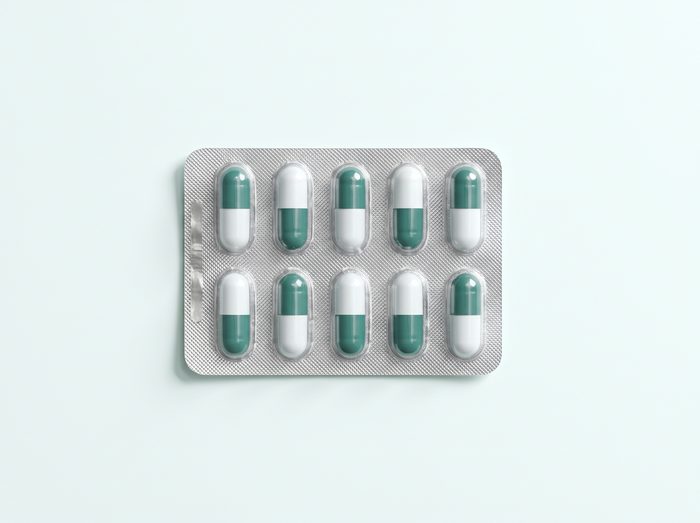
| Parameter | Blister packing at HYPERPHARM |
|---|---|
| Dose forms | Tablets, capsules and softgels; delayed-release tablets and capsules on request |
| Formula | Ready-made (white label) or your own (private label) |
| Minimum run | Tablets and capsules: from 2,000 cartons printed for your brand, at least 4,000 blisters. Softgels: send the softgel size with the enquiry |
| Production time | from 2 weeks; shipping time is added separately |
| Blisters per carton | 1 to 4; more by individual agreement |
| Lidding foil | Printed for your brand |
| Carton | We lay out and print the carton to the label rules of your market, which your importer confirms, and print the lidding foil with your brand. Artwork you already have can be used instead. Your own packaging can be used on request. Only the artwork version you have approved is printed |
| Batch number, production date and expiry date | On the carton; the dates are printed with the carton or applied as the blisters are cartoned, not added as a sticker |
| Blister tooling in place | Oval tablets 22 × 10, 20 × 9.5 and 16 × 8 mm; round tablets 13, 12 and 11 mm; capsules size 0 long (0EL), 0 and 00 |
| Cavities per blister | Classic layout 10 to 15, set by the size of the tablet or capsule. Size 00 capsules: 10 on a 100 × 70 mm card |
| Perforation | Available, so the blister can be separated dose by dose |
| Your own blister, tablet or capsule size | From 25,000 cartons or 50,000 blisters, terms agreed per project |
| Blister machine | Uhlmann B 1240: forms, fills, seals and cuts the blisters in one pass; rated output up to 250 blisters a minute; lidding foil sealed by a flat plate at low temperature |
| Forming area | Up to 128 × 156.5 mm per cycle |
| Forming depth | Up to 24 mm for PVC (thermoforming); cold-formed aluminium is shallower |
| Films offered for your product | PVC, PVC/PVDC and cold-formed aluminium (alu-alu); the film is confirmed in our reply |
| Run records | TouchControl panel with password login and audit trails of production and parameters |
| Cartoner | IMA IC 150: cartons from 28 × 12 × 55 mm to 92 × 60 × 190 mm (width × height × length) |
| With every batch | Certificate of Analysis and specification |
| Site certification | ISO 22000, GMP and HACCP certified, with GMP for food supplements; registered with the US FDA as a food facility. Scope: tablets, capsules, powders. Copies of the certificates with their numbers on request |
| Shelf life | 24 months standard |
| Other packaging | Bottles, tubes, doy-packs and sachets |
| Delivery | Worldwide; EXW by default, FCA or DAP on request |
| Reply to an enquiry | Within 24 hours, Monday to Friday |
Which supplements can be packed in blister packs?
Tablets, capsules and softgels can be packed in blister packs, on a ready-made formula or on your own. Blister packing here is the last stage of making your product under contract: the tablets, capsules or softgels are produced, sealed into blisters and put into a carton printed for your brand.
Ready-made formulas made as tablets, capsules or softgels can go into a blister as well as into a bottle, and so can a formula of your own. The product decides which of the two suits it; the size of the dose decides whether it fits the blister.
Every tablet and capsule we make has its own blister form. Tooling is in place for:
- oval tablets of 22 × 10, 20 × 9.5 and 16 × 8 mm;
- round tablets of 13, 12 and 11 mm;
- capsules in sizes 0 long (0EL), 0 and 00.
A blister of your own design, or a tablet or capsule in a size without tooling, starts from 25,000 cartons or 50,000 blisters, on terms agreed per project. Softgels are sealed on the same Uhlmann B 1240 as tablets and capsules; send the softgel size with the enquiry and the cavity is confirmed in our reply. Delayed-release tablets and capsules are available on request.
Powders, syrups, oils and effervescent tablets are filled into our other packaging: bottles, tubes, doy-packs and sachets.
How does a tablet or capsule end up sealed in a printed carton?
On two machines in sequence: an Uhlmann B 1240 makes and seals the blister, and an IMA IC 150 puts the blisters into the carton.
The Uhlmann B 1240: forming, filling, sealing, cutting
The B 1240 is built by Uhlmann Pac-Systeme in Laupheim, Germany. In one pass it shapes the forming film into cavities, fills them with tablets, capsules or softgels, seals the lidding foil printed for your brand over them and cuts out the finished blisters. According to the machine documentation:
- rated output is up to 250 blisters a minute, a figure Uhlmann also gives on its own product page;
- the forming area is up to 128 × 156.5 mm per cycle;
- cavities are formed up to 24 mm deep in PVC (thermoforming); cold-formed aluminium is shallower;
- the lidding foil is sealed by a flat plate at low temperature;
- the machine is run from a TouchControl panel with password login and audit trails of production and parameters.
The 250 a minute is the ceiling of the machine; the figure to plan with is from 2 weeks of production. The audit trails give each run a record on the machine itself, so the settings it was sealed with can be traced afterwards.
The IMA IC 150: cartoning
The IC 150 is an intermittent-motion cartoner built by IMA in Italy. It takes cartons from 28 × 12 × 55 mm to 92 × 60 × 190 mm (width × height × length) and puts 1 to 4 blisters into each. The batch number, the production date and the expiry date go on the carton; the dates are printed with the carton or applied at this stage as the blisters go in.
How many doses fit on one blister depends on the size of the tablet or capsule, within a forming area of up to 128 × 156.5 mm per cycle.
The full data for both machines: equipment.
What is the minimum order and production time for blister packing?
A blister run starts from 2,000 cartons and at least 4,000 blisters, with production from 2 weeks, the same on a ready-made formula and on your own. The run is counted in cartons and blisters; the minimum for other formats is on minimum order quantity, and production times are on lead times.
- Cartons. Each holds 1 to 4 blisters.
- Lidding foil. Printed for your brand.
- Dates. The batch number, the production date and the expiry date go on the carton.
- Shipping. Added separately to the production time; EXW by default, FCA or DAP on request.
Bottle orders run on different terms; they are set out under "When is a bottle the better pack?" below.
Why do brands choose blisters for supplements?
Because a blister keeps every dose shut until the moment it is pushed out, and shows when a cavity has been opened. What that means in use:
- One cavity, one dose. Pressing a tablet through the foil breaks open its own cavity and no other. A bottle works the other way: each time the cap comes off, room air reaches all the doses still inside.
- Opening is visible. Foil broken over a cavity cannot be sealed again, so an opened or missing dose shows on the card. That is what makes a blister tamper-evident.
- The doses left are easy to count. The card shows how many remain without anything being opened.
- A card can travel alone. One blister can leave the carton for a journey or a day away from home while the others stay inside.
- Your brand is on two surfaces. The carton and the lidding foil are both printed for you.
What the format does not settle by itself is the barrier. How much moisture and oxygen reach a closed cavity depends on the film and the lidding foil, so a blister is not the stronger pack by definition. The two formats side by side: blister or bottle.
Which blister films are offered: PVC, PVC/PVDC or aluminium?
PVC, PVC/PVDC, PET and aluminium laminates, among them cold-formed aluminium (alu-alu), are offered for your product on the Uhlmann line. The lidding is heat-sealable aluminium foil printed with your brand, and paper or polymer lidding with a heat-seal coating is available too. Materials and the blister construction are chosen to suit the product and the protection it needs.
For a sense of scale, take size 00 capsules: a 100 × 70 mm card with 10 cavities of 26 × 10.9 mm, 9.4 mm deep, in 250 µm transparent PVC, sealed with 20 µm hard aluminium foil. The final cavity is set once we have a sample of your product.
The film classes differ in more than barrier. PVC is thermoformed, and on this machine its cavities can be up to 24 mm deep; cold-formed aluminium is shallower, which limits the size of dose a cavity can take, and it is opaque, so the dose cannot be seen through the cavity. Barrier figures in film datasheets also need care: they describe flat film before forming, and as an engineer at a packaging manufacturer has pointed out in a trade article, shaping the cavity thins the laminate, so its barrier can fall with it.
For a product that will also be sold in the EU, film choice has one regulatory side: Regulation (EU) 2025/40 has limited PFAS in food-contact packaging placed on the EU market since 12 August 2026, and fluorinated films such as PCTFE fall under that question.
The films, the foil and what each suits: blister films. Published barrier figures by film, and their limits: blister packaging for hot and humid climates.
When is a bottle the better pack?
When the product keeps longer in a bottle with desiccant, when you need a smaller first order, or when the dose does not suit a blister.
How long the product keeps. A blister is not the stronger pack by default. A 2017 modelling study, published in the trade journal Pharmaceutical Technology, estimated the shelf life of one moisture-sensitive multivitamin tablet containing 100 mg of thiamine at 30 °C/75 % RH, with the bottles modelled at 60 cc holding 30 tablets. It put that tablet at 2.6 years in an HDPE bottle with 2 g of silica gel, 1.7 years in a cold-formed aluminium blister, 1.2 years in a bottle without desiccant and 0.5 years in a PVC blister. Read it as one worked case: a calculation for one product at one condition rather than a test, in a trade journal, with its figure credited to a desiccant supplier. It shows that which pack holds a product longer depends on the product.
Order size and time. A bottle order can start smaller. A ready-made formula starts from 100 units in stock packaging, with production from 2 weeks. Your own formula starts from 500 bottles per product, with production from 4 weeks. Powders, sachets, sports nutrition, syrups and oils are counted in kilograms or litres: see minimum order quantity.
The dose itself. A tablet or capsule in a size without blister tooling needs a run of 25,000 cartons or 50,000 blisters before it can have a blister of its own, on terms agreed per project.
How does a blister order run, step by step?
In seven steps, with the sample and the artwork approved by you before production starts.
- Enquiry. Tell us the dose form, whether the formula is ready-made or your own, how many cartons you plan and the country of sale. We reply within 24 hours, Monday to Friday.
- Sample. For a ready-made formula you receive a sample of the existing product; a formula of your own is first developed into a sample. The sample shows the real size of the tablet or capsule, and with it whether the blister tooling in place fits.
- Approval. You approve the sample, then the artwork for the carton and the lidding foil. Printing waits for your approval of the final version.
- Production. A blister run takes from 2 weeks of production.
- Blister and carton. The Uhlmann B 1240 seals the tablets, capsules or softgels under the foil printed for your brand, and the IMA IC 150 places 1 to 4 blisters in each printed carton, with the batch number, production date and expiry date on the carton.
- Documents. The batch leaves with its Certificate of Analysis and specification; copies of the site certificates are sent on request.
- Delivery. EXW by default, FCA or DAP on request. Shipping time is added to the production time and depends on the destination.
The whole order, bottles included: manufacturing.
Who designs the carton and the lidding foil?
We lay out and print the carton to the label rules of your market, which your importer confirms, and print the lidding foil with your brand. Artwork you already have can be used instead. Your own packaging can be used on request. Only the artwork version you have approved is printed.
The batch number, the production date and the expiry date are on the carton; the dates are printed with the carton or applied as the blisters are cartoned, not added later as a sticker.
Is a blister right for hot and humid markets?
It can be: each dose sits sealed in its own cavity, and an opened cavity is visible; how much moisture reaches a closed cavity depends on the film and foil confirmed for the product and on what the regulator in the country of sale asks for.
WHO's stability guideline ties the long-term test condition to the climatic zone of the market the product is meant for: 30 °C/65 % RH for zone IVa and 30 °C/75 % RH for zone IVb. In WHO's list of stability conditions by country (update of March 2021), Nigeria and Ghana are given 30 °C/75 % RH, which corresponds to zone IVb, while Saudi Arabia, the United Arab Emirates and Egypt are given 30 °C/65 % RH, which corresponds to zone IVa. Both documents were written for medicines, so for a supplement they are a frame of reference rather than law.
Some regulators tie the stability data to the pack itself. Ghana's Food and Drugs Authority, in its guideline for supplements, asks for the studies to be done in the container closure system in which the product will be marketed in Ghana.
The manufacturing group behind HYPERPHARM supplies buyers in every country of Africa, and its main markets are the United Arab Emirates, Saudi Arabia and Lebanon. Registering the product in the country of sale is the brand owner's step, or the importer's; for that file we provide the Certificate of Analysis and specification of each batch, and copies of the site certificates on request.
More on heat, humidity and the pack: blister packaging for hot and humid climates, climatic zones by country and shelf life and storage.
Blister or bottle: which suits my product?
A tablet, capsule or softgel that fits the tooling in place suits a blister: from 2,000 cartons and at least 4,000 blisters, with production from 2 weeks. A bottle in stock packaging takes a ready-made formula from 100 units and your own formula from 500 bottles per product. The product settles more of the blister than the brief does. Below, what each kind of product changes and what that costs you in time, run size or risk.
| Your product | What changes | Trade-off |
|---|---|---|
| A tablet or capsule in a size with tooling in place | It goes onto the blister tooling the plant already has | Run and time: the blister minimum and production time given in the table at the top of this page |
| A tablet or capsule in another size, or a blister of your own design | The blister needs tooling of its own | Run: from 25,000 cartons or 50,000 blisters, on terms agreed per project |
| A softgel | Sealed on the same Uhlmann B 1240 as tablets and capsules | Risk: the size may need a check; send the size of your softgel with the enquiry and the cavity is confirmed in our reply |
| A large tablet or capsule | Cavity depth sets what fits: up to 24 mm for PVC (thermoforming); cold-formed aluminium is shallower | Risk: fewer doses fit on one blister, and an aluminium cavity may not take the dose at all |
| A formula that readily takes up moisture | The film and the lidding foil set how much moisture reaches each closed cavity; a bottle with desiccant is a different route, and in one published model it held one tablet longer than an aluminium blister | Risk: a barrier too low for the formula. Flat-film figures alone do not show how a product keeps in its pack |
| A market whose regulator asks for stability data in the pack you will sell, as Ghana's does | The study is run in the container closure system in which the product will be marketed | Time: under Ghana's guideline the real-time part runs to the end of the shelf life |
| Sale in several countries | The carton is laid out to the labelling rules of each country of sale, which your importer confirms | Risk: the rules differ by country; settle them with your importer before you approve the artwork |
Questions buyers ask about blister packing
What is the minimum order for blister packing?
A blister run starts from 2,000 cartons printed for your brand, at least 4,000 blisters, on a ready-made formula or your own. A blister of your own design, or a tablet or capsule in a size without tooling, starts from 25,000 cartons or 50,000 blisters, on terms agreed per project.
How long does a blister run take?
Production at HYPERPHARM takes from 2 weeks. The sample and your approval of the artwork come before it, and shipping time is added separately; it depends on the destination and the delivery term you choose.
Which supplements can you seal in blisters?
Tablets, capsules and softgels, made at HYPERPHARM to a ready-made formula or to your own; delayed-release tablets and capsules are available on request. Softgels are sealed on the same Uhlmann B 1240; send the softgel size with the enquiry and the cavity is confirmed in our reply. Powders, syrups, oils and effervescent tablets are filled into bottles, tubes, doy-packs or sachets.
Which tablet and capsule sizes fit your blister tooling?
Tooling is in place for oval tablets of 22 × 10, 20 × 9.5 and 16 × 8 mm, round tablets of 13, 12 and 11 mm, and capsules in sizes 0 long (0EL), 0 and 00. Another size, or a blister of your own design, starts from 25,000 cartons or 50,000 blisters, on terms agreed per project.
How many blisters go into one carton?
A HYPERPHARM carton holds 1 to 4 blisters. The cartons are filled on an IMA IC 150, which takes cartons from 28 × 12 × 55 mm to 92 × 60 × 190 mm (width × height × length), and each carton is printed for your brand.
Can the lidding foil carry my brand?
Yes. At HYPERPHARM, we lay out and print the carton to the label rules of your market, which your importer confirms, and print the lidding foil with your brand. Artwork you already have can be used instead. Only the artwork version you have approved is printed.
Where do the batch number, the production date and the expiry date go?
On the carton, printed with it or applied as the blisters are cartoned, not added later as a sticker. The standard shelf life is 24 months.
Which blister films can the machine run?
PVC, PVC/PVDC and cold-formed aluminium (alu-alu) are offered for your product, with heat-sealable aluminium lidding foil printed with your brand; the film is confirmed in our reply.
Is a blister always better than a bottle?
A blister keeps every unopened dose sealed and shows when a cavity has been opened; which pack holds a product longer depends on the product and the film. In a 2017 modelling study of one vitamin tablet at 30 °C/75 % RH, published in a trade journal, a bottle with 2 g of silica gel was estimated to hold it for 2.6 years, against 1.7 years for a cold-formed aluminium blister.
Can I see a sample before the run?
Yes. For a ready-made formula you receive a sample of the existing product; for a formula of your own, a sample is developed first. The sample also shows the real size of the tablet or capsule, and with it whether the blister tooling in place fits.
What documents come with a blister batch?
A Certificate of Analysis and a specification come with every batch. The plant is ISO 22000, GMP and HACCP certified, with GMP for food supplements, and registered with the US FDA as a food facility; the ISO 22000 scope names packaging alongside manufacturing for tablets, capsules and powders. Copies of the certificates with their numbers are sent to clients on request; see quality and batch documents.
Will you register the product in my country?
Registration in the country of sale is filed by the brand owner or the importer, with our documents: the Certificate of Analysis and specification of each batch, and copies of the site certificates on request.
Read more
Equipment · Blister or bottle · Blister packaging for hot and humid climates · Climatic zones by country · Shelf life and storage · White label supplements · Private label supplements · Manufacturing · Quality and batch documents · Tablets in blisters · Capsules in blisters · Blister films · Blister artwork guide
Ask for a quote
Tell us the dose form, whether the formula is ready-made or your own, how many cartons you plan and how many blisters each should hold, and the country of sale. If your tablet or capsule already exists, add its size. We reply within 24 hours, Monday to Friday.
Request a quote → Email sales@hyperpharm.eu
Sources
- Uhlmann Pac-Systeme GmbH & Co. KG, Laupheim, Germany: B 1240 blister machine, manufacturer's page (rated output of up to 250 blisters a minute, platen sealing, forming depth for PVC and for aluminium, forming and lidding materials): https://www.uhlmann.de/en/products-and-solutions/blister-machines/b-1240. Checked 9 October 2026.
- World Health Organization: WHO Technical Report Series No. 1010 (2018), Annex 10, Stability testing of active pharmaceutical ingredients and finished pharmaceutical products; long-term conditions by climatic zone (2.2.7.1 and Appendix 3). extranet.who.int. Checked 9 October 2026.
- World Health Organization: Stability conditions for WHO Member States by Region, update of March 2021 (TRS 953, Annex 2, Appendix 1). who.int. Checked 9 October 2026.
- Food and Drugs Authority, Ghana: Guideline for Registration of Food/Nutritional/Dietary Supplements, FDA/HMD/GL-FS/2012/01, issued 1 March 2013, as published on the authority's website; stability studies in the container closure system in which the product will be marketed, real-time testing to the end of the shelf life. fdaghana.gov.gh. Checked 9 October 2026.
- Logel, Rault, Emond, Waterman, Florez: Why Bottles with Desiccant Outperform Foil-Foil Blister Packaging, Pharmaceutical Technology, 1 September 2017, pp. s32-s34; a modelling study, figure credited to a desiccant supplier. pharmtech.com. Checked 9 October 2026.
- Regulation (EU) 2025/40 on packaging and packaging waste, Article 5(5) on PFAS in food-contact packaging and Article 71 on application from 12 August 2026. eur-lex.europa.eu. Checked 9 October 2026.