| Country | Regional page | Label language in the texts we read | Long-term condition in WHO's list | Apostille |
|---|---|---|---|---|
| Egypt | North Africa | Arabic and English, on the outer and the inner pack (EDA route) | 30 °C/65% RH | Not a party to the Apostille Convention; your importer confirms the route |
| Morocco | North Africa | Arabic for food; USDA reports an exemption for food supplements. Confirm | 25 °C/60% RH | Apostille available. Confirm |
| Algeria | North Africa | Not confirmed; the rules are being rewritten | [25 °C/60% RH], IFPMA estimate | Apostille available from 9 July 2026. Confirm |
| Tunisia | North Africa | Not confirmed | 25 °C/60% RH | Apostille available. Confirm |
| Nigeria | West Africa | English (US export page on processed food) | 30 °C/75% RH (2008) | Not a party to the Apostille Convention; your importer confirms the route |
| Ghana | West Africa | Registration certificates in English; label rule not confirmed | 30 °C/75% RH (2008) | Not a party to the Apostille Convention; your importer confirms the route |
| Côte d'Ivoire | West Africa | Not found in our sources | [30 °C/65% RH], IFPMA estimate | Not a party to the Apostille Convention; your importer confirms the route |
| Senegal | West Africa | Not found in our sources; French is the official language | [30 °C/65% RH], IFPMA estimate | Apostille available. Confirm |
| Kenya | East Africa | English and/or Kiswahili | [30 °C/65% RH], IFPMA estimate | Not a party to the Apostille Convention; your importer confirms the route |
| Tanzania | East Africa | Kiswahili, English or both; stick-on labels prohibited (USDA food import rules) | 30 °C/75% RH (2008) | Not a party to the Apostille Convention; your importer confirms the route |
| Ethiopia | East Africa | English or Amharic | [30 °C/65% RH], IFPMA estimate | Not a party to the Apostille Convention; your importer confirms the route |
| South Africa | This page, section below | Not confirmed. Confirm | 25 °C/60% RH | Apostille available |
Label languages come from regulators' guidelines and US government export guides, mostly written for food or imports in general. WHO's list (March 2021) is written for medicines; square brackets mark an estimate by the International Federation of Pharmaceutical Manufacturers and Associations (IFPMA), not confirmed by the regulator, and "(2008)" a line collected from regulators in 2008. Apostille: HCCH status table, last updated 30 June 2026. "Confirm" means: ask your importer. Checked 9 and 13 October 2026.
Who files the registration, and what do you supply?
You, your importer or a local applicant, depending on the country: Ghana's Food and Drugs Authority (FDA) names the product owner or a licence holder, and a licence holder's representative only if it owns the product; Nigeria's NAFDAC lists a Nigerian company's registration among the documents.
What we supply
- Food supplements under your brand: white label from a ready-made formula, or private label from your own.
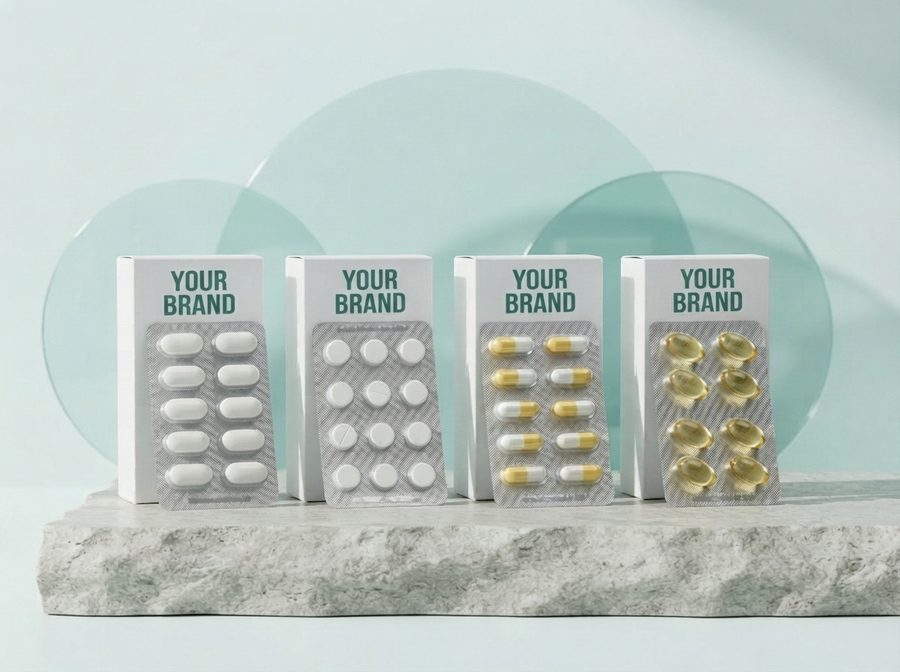
- Tablets, capsules and softgels sealed in blisters on an Uhlmann B 1240, one kind of tablet or capsule per blister.
- We lay out and print the carton to the label rules of your market, which your importer confirms, and print the lidding foil with your brand. Artwork you already have can be used instead.
- The batch number and expiry date on the carton; shelf life is 24 months as standard.
- The Certificate of Analysis and specification with each batch, and copies of the plant's certificates with their numbers on request: ISO 22000, HACCP, and GMP for food supplements.
- Where the country of sale asks for documents to be legalised, legalisation is arranged as well.
- Halal certification for the specific product, not for the plant as a whole.
- A sample before you order, a plant visit, and delivery worldwide: EXW by default, FCA or DAP on request.
What your importer confirms
- How the product is classed (food, supplement or, in some countries, a health product or complementary medicine) and which authority handles it.
- The label language and what else the carton must carry, such as the importer's details or a registration number.
- Which documents the file needs, and whether they go through an apostille or an embassy.
- Whether the regulator expects stability data, and under which condition.
Which language goes on the carton?
It depends on the country, and for a supplement your importer confirms it.
- English. Nigeria: English (a US export page on processed food). Kenya: English and/or Kiswahili (US International Trade Administration, 2024). Tanzania: Kiswahili, English or both (USDA food import rules, January 2026). Ethiopia: English or Amharic (USDA food import rules, 2024).
- Arabic and English. For the products it registers, the Egyptian Drug Authority (EDA) asks for the label data in both languages on the outer and the inner pack. For an aluminium inner pack, the product name, the form and the company name or logo are enough; whether that covers a blister, your importer confirms.
- Morocco. USDA reports that a 2010 order (No. 1379-10) exempts food supplements from the Arabic labelling requirement; ask your importer whether it applies.
- Not confirmed. Ghana, Algeria, Tunisia, Côte d'Ivoire and South Africa. For Senegal we found no rule; French is the official language.
Do my documents need an apostille or an embassy stamp?
It depends on the country of sale: five countries in the table are party to the Apostille Convention and seven are not.
- Party to the Convention. South Africa (since 30 April 1995), Morocco (since 14 August 2016), Tunisia (since 30 March 2018), Senegal (since 23 March 2023) and Algeria (from 9 July 2026).
- Not a party. Egypt, Nigeria, Ghana, Côte d'Ivoire, Kenya, Tanzania and Ethiopia; your importer confirms the route. Two regulators name it: Egypt's EDA asks for the certificate of pharmaceutical product (CPP) to be authenticated by the Egyptian embassy or consulate, and NAFDAC for the Certificate of Manufacture and Free Sale to be authenticated by the Nigerian embassy or high commission. For a free sale certificate for Egypt, your importer confirms.
An apostille is added in the country where a document is issued. It works between two parties unless one has objected to the other's accession; the HCCH table records objections to the accessions of Morocco, Tunisia, Senegal and Algeria, so your importer confirms. The full document set is on export documents.
Is all of Africa zone IVb?
No. WHO's stability list gives the 12 countries in the table three long-term conditions, and five of the lines are only estimates.
- 30 °C/75% RH, which corresponds to zone IVb: Nigeria, Ghana and Tanzania, lines collected from regulators at the 13th International Conference of Drug Regulatory Authorities (ICDRA) in 2008.
- 30 °C/65% RH, which corresponds to zone IVa: Egypt, confirmed through a regional group or by the regulator; Kenya, Ethiopia, Senegal and Côte d'Ivoire as an IFPMA estimate, not confirmed by the regulator.
- 25 °C/60% RH, which corresponds to zone II: Morocco, Tunisia and South Africa, confirmed; Algeria as an IFPMA estimate, not confirmed by the regulator.
WHO's list gives conditions, not zone names; the zone is our reading of each condition against the note to Table A10.4 in WHO's Technical Report Series No. 1010, Annex 10.
A blister keeps each dose sealed until it is pressed out, and how much moisture reaches it depends on the film. More on climatic zones by country, blister packaging for hot and humid markets and shelf life and storage.
South Africa: who regulates supplements, and what goes on the carton?
The rules are not settled: according to a column of 14 August 2026 in Spotlight, a South African health publication, complementary medicines fall under the South African Health Products Regulatory Authority (SAHPRA), but none had yet been registered, so your importer confirms what applies before the carton is printed.
Regulator and status. A supplement may fall into that category depending on how it is classed. The same column says the first notices calling these products up for registration have been repealed, and that under a 2022 Supreme Court of Appeal ruling a preparation that seeks to supplement a diet or provide a nutritional benefit "is not a medicine, but a foodstuff". Ask your importer which statements the label must carry.
Label language. Not confirmed. Your importer confirms the language or languages.
WHO's list. 25 °C/60% RH, confirmed, which corresponds to zone II. For a hotter market, WHO's guideline for medicines warns against relying on zone I and II conditions for zones III and IV.
Documents. We have not read what South Africa asks for; your importer lists the documents. South Africa has been a party to the Apostille Convention since 30 April 1995.
Private label and white label supplements for South Africa. Tablets, capsules and softgels in blister packaging, with a carton printed in the language your importer confirms.
What your product decides
Each line shows what a market costs you in time or risk.
| Your product or market | What changes | What it costs you |
|---|---|---|
| One product for several African countries | Label languages differ: Arabic and English for Egypt; English, Kiswahili or both for Kenya and Tanzania | Time: a carton artwork for each language set, each approved by you before print. Risk: a carton built for one country may not meet another's rules |
| A product for Ghana | Ghana's FDA asks for stability data under WHO zone IVb conditions, in the pack the product is sold in | Time: its guideline names six months of accelerated testing at 40 °C/75% RH and long-term testing to the end of the shelf life |
| A product for Algeria or Tunisia | Rules are being rewritten: Algeria's government has reviewed a draft executive decree; Tunisia has no specific supplement law, and a bill was examined by a parliamentary committee in March 2026 | Risk: requirements may change between artwork and arrival; confirm with your importer before print |
Questions buyers ask about African markets
Do you register supplements in African countries?
No. Registration, where a country asks for it, is filed by you, your importer or a local applicant. We supply the documents the file draws on and the printed carton. Where the country of sale asks for documents to be legalised, legalisation is arranged as well.
Is all of Africa zone IVb?
No. Of the 12 countries on this page, WHO's list gives 30 °C/75% RH, which corresponds to zone IVb, only to Nigeria, Ghana and Tanzania.
Is WHO's list a legal requirement for supplements?
No. It was written for medicines: it records the long-term conditions Member States notified to WHO for registering medicines, plus IFPMA estimates in square brackets. For a supplement, the regulator in the country of sale decides.
Which African markets name English as the label language?
In the texts we read: Egypt (Arabic and English), Nigeria (English), Kenya and Tanzania (English, Kiswahili or both) and Ethiopia (English or Amharic). Except Egypt's, these rules are written for food or imports in general; for a supplement, your importer confirms.
Does a supplement need SAHPRA registration in South Africa?
The answer is not settled. Spotlight wrote on 14 August 2026 that no complementary medicine had yet been registered with SAHPRA and that the first notices calling these products up for registration had been repealed. Your importer confirms.
Can a sticker correct the label after the goods arrive?
Not everywhere. USDA's January 2026 report on food imports into Tanzania says stick-on labels are strictly prohibited. For Nigeria, a US export page on processed food says stick-on labels meeting NAFDAC requirements are "permitted provided they don't remove easily", and that a foreign label must be "applied prior to export". For Morocco, USDA's May 2023 report, written before the November 2023 circular, says an importer may apply an Arabic sticker to food after arrival with the approval of ONSSA, the food safety office, if the importer shows the supplier cannot print Arabic; for a supplement, your importer confirms.
Who issues a certificate of free sale?
An authority in the country of origin. Nigeria and Ethiopia ask for one, and Nigeria wants it authenticated by its embassy or high commission. Egypt asks for a CPP or free sale certificate from an authority in the country of origin or, where the EDA's rules ask for it, in a reference country; your importer confirms which.
Do you already supply clients in Africa?
Yes. The manufacturing group behind HYPERPHARM already supplies many clients in Africa; we do not list their countries. The group exports to 42 countries.
Read more
North Africa · West Africa · East Africa · Middle East · Climatic zones by country · Blister packaging for hot and humid markets · Shelf life and storage · Export documents · Blister packing · Quality and certificates · White label supplements · Private label supplements
Ask about your African market
Tell us the product, the countries and what your importer has asked for. We reply within 24 hours, Monday to Friday.
A blister run with a carton printed for your brand starts from 2,000 cartons, at least 4,000 blisters, with a ready-made formula or your own, and production takes 6 to 10 weeks. Each carton holds 1 to 4 blisters, and the lidding foil carries your brand too.
Request a quote → Email sales@hyperpharm.eu
Sources
- World Health Organization: Stability conditions for WHO Member States by Region, update of March 2021, published as Appendix 1 to Annex 2 of WHO Technical Report Series No. 953. Written for medicines; gives long-term testing conditions, not zone names; footnotes 1 to 3 give the three sources of its entries. Page on who.int; PDF on cdn.who.int. Checked 9 October 2026.
- World Health Organization: Technical Report Series No. 1010 (2018), Annex 10, Stability testing of active pharmaceutical ingredients and finished pharmaceutical products. Parts used: section 2.2.7 (zone I and II conditions for zones III and IV) and the note to Table A10.4 (conditions for zones II, IVa and IVb). extranet.who.int. Checked 9 October 2026.
- Hague Conference on Private International Law (HCCH): status table of the Apostille Convention, last updated 30 June 2026; parties, dates of entry into force and objections to accessions. hcch.net. Checked 9 and 13 October 2026.
- Egyptian Drug Authority: executive procedures of Decree 572/2022, GL.CAPP.035, issued 22 September 2022, in force from 2 October 2022. Parts used: section "Cards" (Arabic and English on the outer and inner pack; aluminium inner pack) and the documents for imported products (reference country; CPP authenticated by the Egyptian embassy or consulate). edaegypt.gov.eg. Checked 9 and 13 October 2026.
- National Agency for Food and Drug Administration and Control (NAFDAC), Nigeria: Guidelines for Registration of Imported Herbal Remedies/Dietary Supplements in Nigeria, R&R-GDL-007-00, effective 1 June 2018, with a review date of 31 May 2023; ask your importer whether it is still in force (copy on policyvault.africa). policyvault.africa. Checked 9 and 13 October 2026.
- US Alcohol and Tobacco Tax and Trade Bureau (TTB): International affairs resources for Nigeria. Written for processed food; the page shows update dates of 29 September 2010 and 15 April 2024. ttb.gov. Checked 9 and 13 October 2026.
- Food and Drugs Authority, Ghana: Guideline for Registration of Food/Nutritional/Dietary Supplements, FDA/HMD/GL-FS/2012/01, issued 1 March 2013 (applicant; certificates in English; stability under WHO zone IVb conditions). fdaghana.gov.gh. Checked 9 and 13 October 2026.
- US International Trade Administration: Kenya, Labeling/Marking Requirements, 5 July 2024. trade.gov. Checked 9 October 2026.
- USDA Foreign Agricultural Service: Food and Agricultural Import Regulations and Standards (FAIRS) country report, Tanzania, TZ2025-0018, 15 January 2026; written for food (copy on agriexchange.apeda.gov.in). PDF. Checked 13 October 2026.
- USDA Foreign Agricultural Service: FAIRS country report, Ethiopia, ET20240018, 11 October 2024; written for food (copy on agriexchange.apeda.gov.in). PDF. Checked 13 October 2026.
- USDA Foreign Agricultural Service: FAIRS country report, Morocco, MO2023-0005, 9 May 2023; written for food, before the circular of November 2023 (order 1379-10; Arabic stickers after arrival with ONSSA approval) (copy on agriexchange.apeda.gov.in). PDF. Checked 9 and 13 October 2026.
- AllAfrica (French edition), 12 March 2026: Tunisia's parliamentary health committee heard manufacturers on a bill on food supplements; no specific law yet. fr.allafrica.com. Checked 13 October 2026.
- La Presse de Tunisie, 9 May 2026: pharmacists' union asks for health ministry control of food supplements. lapresse.tn. Checked 9 October 2026.
- Spotlight, 14 August 2026: column on the regulation of complementary medicines in South Africa (call-up notices, registrations, the 2022 Supreme Court of Appeal ruling). spotlightnsp.co.za. Checked 13 October 2026.