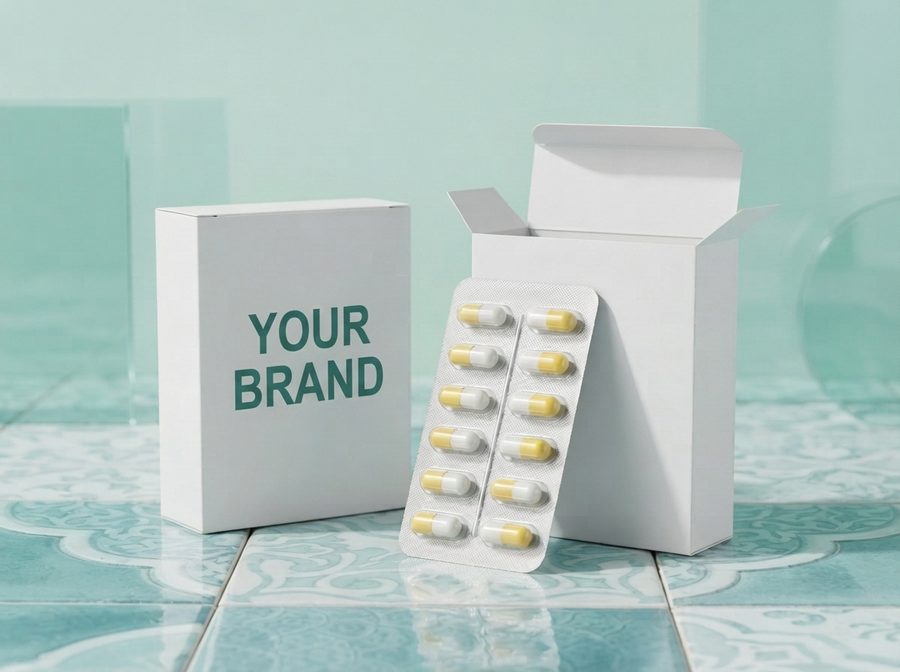
HYPERPHARM is a European manufacturer of private label supplements, made in the EU, for importers and distributors in Egypt, Morocco, Algeria and Tunisia. Tablets, capsules and softgels are sealed in blisters with a carton printed for your brand, from 2,000 cartons and at least 4,000 blisters, from 2 weeks of production. A Certificate of Analysis comes with each batch.
For products the Egyptian Drug Authority (EDA) registers, Arabic and English go on carton and inner pack, and an Egyptian embassy or consulate certifies the CPP. Morocco requires registration with its medicines agency (AMMPS), press reports say, with number and importer on the pack. Algeria's and Tunisia's rules are unsettled. Your importer files; we supply product, carton and batch documents.
| Country | Authority | Label language | Who files | WHO long-term condition | Documents certified by |
|---|---|---|---|---|---|
| Egypt | EDA, for the category Decree 572/2022 defines | Arabic and English, outer and inner pack | Your importer or a local applicant | 30 °C/65% RH, confirmed (zone IVa) | Egyptian embassy or consulate for the CPP (EDA procedures) |
| Morocco | AMMPS, prior registration (circular No. 834, 2023, press report); ONSSA on the committee | Arabic for food; USDA reports a supplement exemption | Your importer or a local applicant | 25 °C/60% RH, confirmed (zone II) | Apostille available; party since 14 August 2016 |
| Algeria | Not settled: Law 18-11 (2018), draft decree (reported April 2026) | Depends on the product class | Your importer or a local applicant | [25 °C/60% RH], IFPMA estimate | Apostille available from 9 July 2026, according to the HCCH table of 30 June 2026 |
| Tunisia | No specific supplements law; bill before a parliamentary committee, March 2026 | Your importer confirms for your product | Your importer or a local applicant | 25 °C/60% RH, confirmed (zone II) | Apostille available; party since 30 March 2018 |
WHO's list (March 2021) is written for medicines; for supplements it is a reference. "Confirmed" lines came from a regional group or the regulator; square brackets mark an estimate by the International Federation of Pharmaceutical Manufacturers and Associations (IFPMA). The zone is read from the condition. Apostille status follows the table of the Hague Conference (HCCH) as of 30 June 2026; an apostille works between two parties unless one has objected to the other's accession.
Who registers a supplement in Egypt?
Your importer or another local applicant; your importer also confirms which Egyptian authority handles your product. Decree 572/2022 defines a category registered only by the EDA and circulating only in licensed pharmaceutical establishments; check whether your supplement falls in it.
What must the carton and the blister foil carry for Egypt?
Arabic and English, on the outer and the inner pack. The decree's executive procedures (GL.CAPP.035) list in the section headed Cards: trade name, active ingredients, form, number of units, storage conditions, company and site, logo, EDA registration number, batch number, and production and expiry dates; the price goes on the outer pack.
For an inner pack made of aluminium, the product name, the pharmaceutical form and the company name or logo are enough. On a blister, that minimum would sit on the printed lidding foil and the other data on the carton, if the EDA reads your blister this way, which is for your importer to verify.
For an imported product, the procedures also ask for a commitment to add the importer's name, address and telephone number in Arabic, the price and the registration number. Plan the carton artwork with room for them. The procedures also ask the company to submit a product leaflet with the file; we put a printed leaflet into the carton, to your artwork.
On our blister cartons, the production date and the expiry date are printed with the carton or applied as the blisters are packed, not stuck on; the batch number is on the carton too.
Which documents does Egypt ask for, and who certifies them?
A certificate of pharmaceutical product (CPP), certified by an Egyptian embassy or consulate, or a free sale certificate. The procedures also expect the product to be on the market in a reference country under the same name and composition, and ask for a stability study and an analysis of the imported batch. We arrange the free sale certificate; the EDA's text says it comes from the country of origin or, where its rules ask for it, a reference country, and your importer checks which applies.
The procedures define the manufacturer as a licensed factory that meets the good manufacturing requirements the EDA approves. The plant's GMP certification is for food supplements; ask your importer how the EDA treats it.
The EDA's 2022 stability guideline, written for pharmaceutical products, places Egypt in zone IVa; see climatic zones by country and hot and humid markets.
How is a supplement registered for Morocco, and what goes on the pack?
By prior registration with AMMPS, Morocco's medicines and health products agency; the imported pack then carries the registration number and the importer's name and address. A July 2026 press report citing ONSSA, the food safety office, bases this on joint circular No. 834 of 14 November 2023, with ONSSA on the technical committee. Your importer or a local applicant files; plan the carton artwork with room for the number and the importer's details.
The label language is not settled for supplements. A USDA report of May 2023, before the circular, says Order 1379-10 of 2010 exempts food supplements from Morocco's Arabic labelling requirement, and that for food the importer may add an Arabic sticker after arrival with ONSSA's approval if the importer shows the supplier cannot print Arabic. Whether AMMPS expects Arabic, French or both is to be agreed with your importer.
For food supplements, a 2025 USDA report lists a certificate of conformity or a laboratory analysis showing the contents match the label, and proof of registration with the health ministry; whether our Certificate of Analysis serves is for your importer to judge.
According to the Moroccan press, Law 27-26, adopted at the end of June 2026, reserves certain food supplements to the pharmacy channel; an implementing decree is still to set which. Your importer confirms where your product stands.
Can I sell supplements in Algeria?
Only once your importer confirms the rules in force, because Algeria is rewriting them. Law 18-11 of 2018 treats part of the range as pharmaceutical products requiring registration, and in April 2026 the press reported that the government had reviewed a draft decree on specifications, permitted vitamins and minerals and maximum doses. The HCCH table gives the apostille from 9 July 2026; confirm with your importer.
What applies in Tunisia?
No specific law covers supplements yet, so the authority, the label language and the documents are still to be established. A parliamentary committee examined a bill in March 2026, and in May the pharmacists' union asked for health ministry control.
What we supply and what your importer confirms
Filing in these countries is your importer's or a local applicant's step. The manufacturing group behind HYPERPHARM supplies buyers in every country of Africa.
From us
- Supplements under your brand, from a ready-made formula or your own.
- Tablets, capsules and softgels sealed in blisters on an Uhlmann B 1240 and cartoned on an IMA IC 150, one kind of tablet or capsule per blister (blister packing).
- We lay out and print the carton to the label rules of your market and print the lidding foil with your brand. Artwork you already have can be used instead.
- Batch number, production date and expiry date on the carton; standard shelf life 24 months, stated in the product documents (shelf life and storage).
- Certificate of Analysis and specification with each batch; copies of the plant's certificates with their numbers on request. ISO 22000 and HACCP certified, GMP certified for food supplements, registered with the FDA as a food facility (quality).
- We arrange the Certificate of Free Sale, the Certificate of Manufacture, the apostille and consular legalisation where the country of sale asks for them.
- Samples before an order and a plant visit on request; delivery worldwide, EXW by default, FCA or DAP on request.
From your importer
- The authority, the filing and the label rules, including whether a sticker is allowed.
- The registration number, the importer's details and, for Egypt, the price.
- What the file needs from the country of origin, such as a free sale certificate or CPP (export documents).
What your product decides
Each line shows what it means for time or risk.
| Your product or market | What changes | Trade-off |
|---|---|---|
| Egypt, a product the EDA registers | Arabic and English on carton and inner pack; CPP via an Egyptian embassy or consulate; free sale certificate | Time: embassy certification and the EDA file come before the first shipment |
| Morocco | Registration number and importer's details on the pack | Time: the number comes only after registration; ask your importer when it is added |
| One product for Egypt and Morocco | Languages may differ; numbers and importer details differ; embassy for Egypt, apostille where Morocco asks for a certified document | Time: two carton designs to prepare and approve, and two document routes |
| A moisture-sensitive formula for Egypt and for Morocco or Tunisia | WHO's list gives Egypt 30 °C/65% RH, Morocco and Tunisia 25 °C/60% RH | Risk: data at 25 °C/60% RH may not cover 30 °C/65% RH; for medicines, WHO warns against relying on zone I and II conditions for zone IV markets. Ask your importer what the regulator accepts |
Questions buyers ask about Egypt and the Maghreb
Which languages must an Egyptian carton and inner pack carry?
Arabic and English, on the outer and the inner pack, for a product the EDA registers. An aluminium inner pack may carry just the product name, the pharmaceutical form and the company name or logo.
What is the minimum on the aluminium inner pack in Egypt?
The product name, the pharmaceutical form and the company name or logo; the batch number, dates, registration number and price then go on the outer pack.
Who files the registration in Egypt and Morocco?
Your importer or another local applicant: with the Egyptian authority that handles the product in Egypt, with AMMPS in Morocco. We supply the product, the carton and the batch documents.
Apostille or embassy for documents going to Egypt and Morocco?
Embassy for Egypt: an Egyptian embassy or consulate certifies the CPP, and Egypt is not a party to the Apostille Convention. Morocco has been a party since 14 August 2016; whether AMMPS asks for a certified document at all is for your importer to confirm.
What is new in Morocco: the 2023 circular and a 2026 law?
Joint circular No. 834 of 14 November 2023 is, by a 2026 press report citing ONSSA, the basis for AMMPS registration. According to the Moroccan press, Law 27-26, adopted at the end of June 2026, reserves certain food supplements to the pharmacy channel; an implementing decree is still to set which.
Must a supplement label for Morocco be in Arabic?
A May 2023 USDA report, from before the circular, says Order 1379-10 exempts food supplements from Morocco's Arabic labelling requirement.
Is Algeria open to supplement imports?
Confirm with your importer first: the rules are being rewritten.
Which storage condition does WHO list for these four countries?
30 °C/65% RH for Egypt, corresponding to zone IVa; 25 °C/60% RH for Morocco and Tunisia, zone II; for Algeria only an IFPMA estimate of 25 °C/60% RH.
Read more
Private label supplements for Algeria · Private label supplements for Tunisia · Egypt · Morocco · Climatic zones by country · Hot and humid markets · Shelf life and storage · Blister packing · Quality · White label supplements · Private label supplements · Export documents · Middle East · West Africa · East Africa · Africa · Blister or bottle · Blister artwork guide · Blister films · Pre-arrival filings: Egypt, Nigeria, Kenya · EU food preparation exports by market · HS codes for food supplements
Ask about your product for Egypt and the Maghreb
Tell us the product, the country of sale, the pack and what your importer has asked for. We answer within 24 hours, Monday to Friday.
A blister run with a carton printed for your brand starts from 2,000 cartons (at least 4,000 blisters), and production time is from 2 weeks. Each carton holds 1 to 4 blisters, and the lidding foil is printed for your brand.
Request a quote → Email sales@hyperpharm.eu
Sources
- Egyptian Drug Authority: Decree 572/2022 of the Chairman of the Egyptian Drug Authority (registration of the category the decree defines; registration only with the EDA; circulation in licensed pharmaceutical establishments). edaegypt.gov.eg. Checked 13 October 2026.
- Egyptian Drug Authority: GL.CAPP.035, Executive procedures of decree 572/2022. Parts used: definitions (manufacturer as a licensed factory meeting the good manufacturing requirements the EDA approves; free sale certificate; reference country); conditions for imported products (reference country; CPP issued in a reference country and certified by an Egyptian embassy or consulate; free sale certificate as the alternative; issuing authority in the country of origin or a reference country); stability study; analysis of the imported batch; section Cards, page 13 (label languages and data, aluminium inner pack, importer's undertaking); Leaflets (leaflet submitted with the product file). edaegypt.gov.eg. Checked 13 October 2026.
- Egyptian Drug Authority: Guidelines on Stability Testing of Finished Pharmaceutical Products and Active Drug Substance, EDREX: GL.CAPP.018, version 4/2022. Written for pharmaceutical products. edaegypt.gov.eg. Checked 13 October 2026.
- World Health Organization: Stability conditions for WHO Member States by Region, update of March 2021, Appendix 1 to Annex 2 of WHO Technical Report Series No. 953. Written for medicines; gives long-term conditions, not zone names. who.int. Checked 9 October 2026.
- World Health Organization: Technical Report Series No. 1010 (2018), Annex 10, Stability testing of active pharmaceutical ingredients and finished pharmaceutical products. Parts used: note to Table A10.4 (conditions for zones II, IVa and IVb) and section 2.2.7 (zone I and II conditions for zones III and IV). extranet.who.int. Checked 9 October 2026.
- Hague Conference on Private International Law (HCCH): status table of the Apostille Convention, last updated 30 June 2026. Morocco from 14 August 2016, Tunisia from 30 March 2018, Algeria from 9 July 2026; Egypt not listed. hcch.net. Checked 13 October 2026.
- TelQuel: How Morocco's supplement market outpaces regulation, 27 July 2026. Press report citing ONSSA: prior registration with AMMPS, joint circular No. 834 of 14 November 2023, technical committee, registration number and importer on imported products. Your importer checks the circular itself. telquel.ma. Checked 13 October 2026.
- US Department of Agriculture, Foreign Agricultural Service: Morocco, Food and Agricultural Import Regulations and Standards Country Report, MO2023-0005, 9 May 2023. Order 1379-10 and the Arabic labelling requirement; Arabic stickers for food. agriexchange.apeda.gov.in (copy on agriexchange.apeda.gov.in). Checked 13 October 2026.
- US Department of Agriculture, Foreign Agricultural Service: Morocco, FAIRS Export Certificate Report, MO2025-0006, 24 March 2025. Documents for food for special uses, including food supplements. agriexchange.apeda.gov.in (copy on agriexchange.apeda.gov.in). Checked 13 October 2026.
- LesEco.ma: Law 27-26 and food supplements in the pharmacy channel, 20 July 2026. Press report: law adopted at the end of June 2026; an implementing decree is to set which supplements. leseco.ma. Checked 13 October 2026.
- AllAfrica (French edition): Tunisia's parliamentary health committee hears supplement manufacturers on a proposed law, 12 March 2026. fr.allafrica.com. Checked 13 October 2026.
- La Presse de Tunisie: pharmacists call for strict control of food supplements, 9 May 2026. lapresse.tn. Checked 13 October 2026.