| Question | South Africa | Source, checked 18 October 2026 |
|---|---|---|
| Who regulates a supplement | It depends on the class. As a medicine, SAHPRA, where "health supplements" are a sub-category of Category D complementary medicines under the Medicines and Related Substances Act 101 of 1965. As a foodstuff, the Foodstuffs, Cosmetics and Disinfectants Act 54 of 1972 and its labelling regulations. Your importer confirms the class. | SAHPRA Roadmap for complementary medicines, v2.3; Regulation R.146 of 2010 |
| Registration with SAHPRA | No complementary medicine had yet been registered, and the initial call-up notices had been repealed, according to a Spotlight column of 14 August 2026 | Spotlight |
| Court ruling | In 2022 the Supreme Court of Appeal found the 2017 General Regulations ultra vires and invalid because they purported to regulate substances that are not medicines under the Act | SCA media summary, [2022] ZASCA 49 |
| Who imports | On the medicine route, importers and wholesalers hold a SAHPRA licence under section 22C(1)(b) | SAHPRA Roadmap v2.3 |
| Label language (food rules) | English, and where possible at least one other official language of South Africa | R.146, regulation 7(1)(a) |
| Batch and date (food rules) | A batch number on the container; a date preceded by "best before", "use by" or "sell by" | R.146, regulations 11 and 12 |
| WHO long-term condition | 25 °C/60% RH, which corresponds to zone II | WHO stability list, March 2021 |
| Apostille | Party to the Apostille Convention since 30 April 1995 | HCCH status table |
Can I get private label or white label supplements for South Africa?
Yes. White label uses one of more than 500 ready-made formulas, with new ones added every month; private label is made to your own formula. Both can go into a blister with a printed carton or into bottles, tubes, pouches and sachets.
A ready-made formula starts from 100 units in stock packaging, with production from 2 weeks. Your own formula starts from 500 bottles per product, with production from 4 weeks. Full figures by format are on the minimum order page.
The plant designs and prints the label and carton, or prints from your artwork. Delivery is worldwide, EXW by default, FCA or DAP on request, and we send samples before an order. The manufacturing group behind HYPERPHARM supplies buyers in every country of Africa.
What is the minimum for blister packaging with my brand?
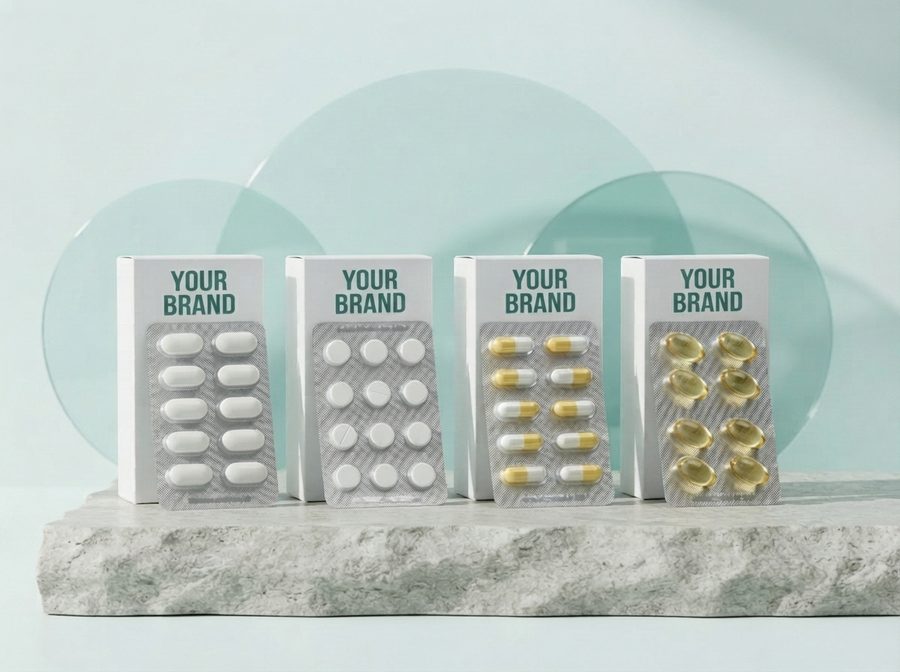
A blister run starts from 2,000 cartons (at least 4,000 blisters), with a ready-made formula or your own, and production takes 6 to 10 weeks. Each carton holds 1 to 4 blisters, one kind of tablet or capsule per blister, and the lidding foil is printed with your brand.
Tablets and capsules are sealed on an Uhlmann B 1240 and cartoned on an IMA IC 150. Tooling is in place for oval tablets of 22 × 10, 20 × 9.5 and 16 × 8 mm, round tablets of 13, 12 and 11 mm, and capsules in sizes 0 long, 0 and 00. A blister or tablet size of your own starts from 25,000 cartons or 50,000 blisters, on terms agreed per project. More on tablets in blisters and capsules in blisters.
Do supplements need SAHPRA registration in South Africa?
That turns on the class, and your importer confirms it with SAHPRA. SAHPRA's roadmap for complementary medicines places "health supplements" in Category D and allows them "only LOW RISK indications and substances". Spotlight wrote on 14 August 2026 that no complementary medicine had yet been registered and that the initial call-up notices had been repealed.
The Supreme Court of Appeal ruled on 11 April 2022, in Minister of Health v Alliance of Natural Health Products, that the General Regulations of 2017 were ultra vires and invalid because they purported to regulate substances that are not medicines under the Act. Spotlight's columnist reads this as meaning that a preparation taken to supplement the diet or for a nutritional benefit is a foodstuff, not a medicine.
While a Category D product is unregistered, SAHPRA's roadmap asks for this statement on the label: "This unregistered medicine has not been evaluated by the SAHPRA for its quality, safety or intended use." If your product takes the medicine route, the statement goes into the carton artwork before print.
What must a supplement label show in South Africa?
If the product is a foodstuff, Regulation R.146 of 1 March 2010 applies: label text in English and, where possible, at least one other official language; a batch number; a date marked "best before", "use by" or "sell by"; and, for an imported product, the manufacturer's name and address and the country of origin. Your importer confirms which version of the rules is in force.
R.146 also bars the word "cure" and any other medicinal claim, and asks for labels that cannot be separated from the container at the point of sale.
The carton carries the production date, the expiry date and the batch number. The wording around the date and the language beside English are set in the layout; see the blister artwork guide.
Which documents come with each batch?
A Certificate of Analysis and a specification come with each batch. Copies of the plant's certificates are sent on request: ISO 22000, GMP and HACCP certified, and FDA registered as a food facility. We also arrange the Certificate of Free Sale, the Certificate of Manufacture, the apostille and consular legalisation where the country of sale asks for them. South Africa has been a party to the Apostille Convention since 30 April 1995. More on export documents and quality.
What your product decides
The right column shows the cost in time, quantity or risk.
| Your product or plan | What changes | Trade-off |
|---|---|---|
| A vitamin or mineral formula sold as a foodstuff | R.146 labelling: English and, where possible, a second official language; batch number; date marking; no medicinal claims | Time: the importer reviews the artwork before print |
| A product classed as a Category D complementary medicine | A SAHPRA-licensed importer, the SAHPRA statement on the label while unregistered | Risk: if the class changes after print, the carton and foil are reprinted |
| A claim that refers to a disease | Barred for foodstuffs; outside the low-risk indications for health supplements | Risk: a rewrite of carton, foil and website |
| Tablets or capsules in a blister | One kind per blister, each dose sealed until it is pushed out | Quantity and time: from 2,000 cartons, 6 to 10 weeks of production |
| A tablet or capsule size of your own | A blister made for it | Quantity: from 25,000 cartons or 50,000 blisters |
Questions buyers ask about supplements for South Africa
Is there a supplement manufacturer for South African brands that makes white label products?
Yes. HYPERPHARM makes white label supplements from more than 500 ready-made formulas and private label from your own formula, made in the EU and shipped worldwide. Tablets, capsules and softgels can be sealed in blisters with a carton printed for your brand.
What is the minimum for blister packaging under my brand?
From 2,000 cartons and at least 4,000 blisters, with 6 to 10 weeks of production. Each carton holds 1 to 4 blisters, and the lidding foil is printed with your brand.
Are supplements registered with SAHPRA?
Health supplements are a sub-category of Category D complementary medicines in SAHPRA's roadmap. Spotlight wrote on 14 August 2026 that none had yet been registered and that the initial call-up notices had been repealed. Your importer, who holds the SAHPRA licence on the medicine route, confirms the class.
Which language goes on a supplement label in South Africa?
Under the food labelling regulations R.146 of 2010, English and, where possible, at least one other official language.
What does "This unregistered medicine has not been evaluated by the SAHPRA" mean on a supplement?
It is the statement SAHPRA's roadmap asks for on Category D products that are not yet registered. If your importer confirms the medicine route, it is printed into the carton artwork.
Where do the batch number and expiry date go on a blister product?
On the carton, with the production date. They are printed with the carton or added when the blisters are packed into it. R.146 asks for a batch number and a date preceded by "best before", "use by" or "sell by" on foodstuffs.
What climate condition does WHO list for South Africa?
25 °C/60% RH, which corresponds to zone II. The list was written for medicines.
Do South African buyers accept an apostille on export documents?
South Africa has been a party to the Apostille Convention since 30 April 1995. We arrange the apostille, the Certificate of Free Sale and the Certificate of Manufacture; the country of sale asks for the ones it needs.
Read more
Africa · For distributors · Blister packing · Blister or bottle · White label supplements · Private label supplements · Minimum order quantity · Lead times · Export documents · Climatic zones by country · Pharmacy own brands · Blister artwork guide · Blister films · Supplement or medicine in Nigeria, Ghana, Kenya and South Africa
Ask about supplements for South Africa
Send us the product, the format, the quantity and anything your importer has asked for. We answer within 24 hours, Monday to Friday.
Request a quote → Email sales@hyperpharm.eu
Sources
- SAHPRA: Roadmap and transitional process for the regulation of complementary medicines, v2.3, December 2021. Used for: health supplements in Category D, low-risk indications and substances, licence under section 22C(1)(b), the label statement for unregistered Category D products. sahpra.org.za. Checked 18 October 2026.
- Spotlight: Inside The Box with Dr Andy Gray, "Are complementary medicines effectively regulated in South Africa?", column of 14 August 2026. Used for: no complementary medicine registered yet, call-up notices repealed, licensing, the columnist's reading of the 2022 ruling. spotlightnsp.co.za. Checked 18 October 2026.
- Supreme Court of Appeal of South Africa: media summary, Minister of Health and Another v Alliance of Natural Health Products (South Africa), case no 256/2021, [2022] ZASCA 49, 11 April 2022. supremecourtofappeal.org.za. Checked 18 October 2026.
- Department of Health: Regulations relating to the Labelling and Advertising of Foodstuffs, Government Notice R.146, Government Gazette No. 32975, 1 March 2010, under Act 54 of 1972; regulations 7, 9, 10, 11, 12 and 13. Copy of the Gazette on skdm.co.za; Department of Health statement on gov.za. Checked 18 October 2026.
- HCCH: Status table of the Apostille Convention, last update 30 June 2026. hcch.net. Checked 13 October 2026.
- World Health Organization: Stability conditions for WHO Member States by Region, update of March 2021; WHO Technical Report Series No. 1010, Annex 10, note to Table A10.4. who.int. Checked 9 October 2026.