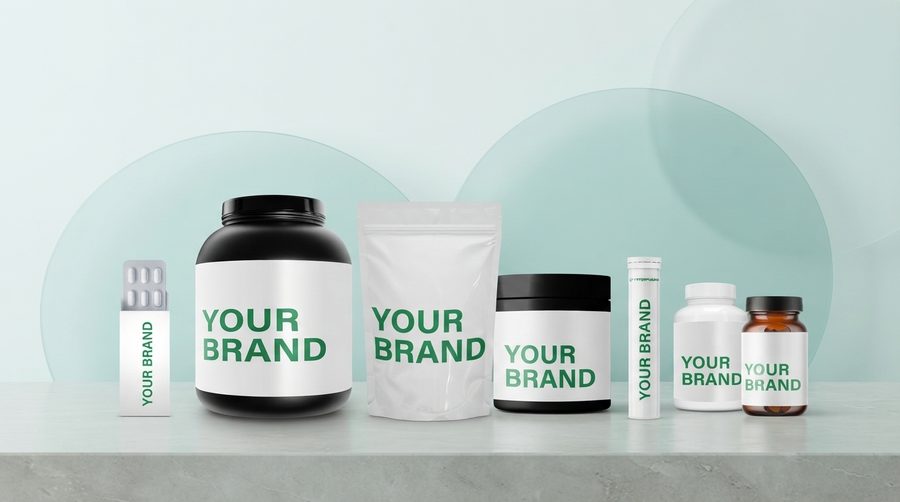
| Parameter | Effervescent tablets at HYPERPHARM |
|---|---|
| Format | A tablet that is dropped into water, fizzes and dissolves, and is then drunk |
| Formula | Ready-made (white label) or your own (private label); which applies to your product is confirmed in our reply |
| Pack | A tube of 20 tablets |
| Tablet | 4 g, made on a sorbitol base |
| Minimum order | Low minimum order, by tube count; the exact number is given in our reply to your enquiry |
| Production time | On lead times; transport is added on top |
| Tube artwork | We lay out and print the tube artwork to the label rules of your market, which your importer confirms. Artwork you already have can be used instead. Only the artwork version you have approved is printed |
| Shelf life | 24 months standard, stated in the product documents |
| With every batch | Certificate of Analysis and specification |
| Site certification | ISO 22000, GMP and HACCP certified, with GMP for food supplements; registered with the US FDA as a food facility. The scope names tablets, capsules and powders; for effervescent tablets the certificates stand as those of the site. Copies of the certificates with their numbers on request |
| Halal | Halal certification is arranged for the specific product rather than for the plant as a whole |
| Sample | Yes, before you order: a sample of the existing product for a ready-made formula, or one developed first for your own |
| Delivery | Worldwide; EXW by default, FCA or DAP on request |
| Reply to an enquiry | Within 24 hours, Monday to Friday |
What goes into a tube, and can it be my own formula?
A tube holds 20 tablets of 4 g, made on a sorbitol base, to a ready-made formula or your own; which applies to your product is confirmed in our reply to your enquiry.
- A ready-made formula (white label). More than 500 ready-made formulas are in production across our formats. They are not listed by name on this site: name the category, the format and the country of sale, and we send a selection of ready-made formulas for that category. You receive a sample of the existing product before you order.
- A formula of your own (private label). Send the composition with your enquiry, and our reply confirms whether it can be made as an effervescent tablet. If it can, it is developed for your brand into a sample first, and production starts once you have approved the sample and then the tube artwork.
What is the minimum order for effervescent tablets?
A low minimum order, by tube count.
The exact number of tubes is given in our reply to your enquiry. Say how many tubes you plan for the first run; prices are quoted for each enquiry rather than published.
Other formats are counted their own way, and each has a minimum of its own:
- tablets and capsules in a blister run, in cartons and blisters;
- tablets and capsules outside the blister, in units for a ready-made formula and in bottles for your own;
- powders and sachets, in kilograms;
- syrups and oils, in litres.
Every figure is on minimum order quantity.
How does an effervescent order run, and how long does it take?
Production from 4 weeks, on a ready-made formula or your own; see lead times. The order runs in seven steps:
- Enquiry. Ready-made or your own formula, the number of tubes and the country of sale. We reply within 24 hours, Monday to Friday.
- Sample. For a ready-made formula, a sample of the existing product; for your own, a sample developed to your brief.
- Approval. You approve the sample, then the tube artwork. Only the version you have approved is printed.
- Production. The batch is made to the composition you approved.
- Tube. The tablets go into tubes of 20 carrying your brand.
- Documents. The batch leaves with its Certificate of Analysis and specification; copies of the plant's certificates are sent on request.
- Delivery. Worldwide: EXW by default, FCA or DAP on request. Transport is added to the production time and depends on the destination.
The production time leaves out the enquiry, the sample and your approvals before it, transport after it, and registration in the country of sale, which the brand owner or the importer files.
Which pack do effervescent tablets go into, and where does the blister come in?
A tube of 20 tablets. The blister, in a carton printed for your brand, is our main pack and is used for tablets, capsules and softgels; drink cubes are each sealed in a blister of their own.
An effervescent tablet is made to fizz and dissolve in water, which makes it sensitive to moisture.
A blister answers a different need. It seals every tablet, capsule or softgel in a cavity of its own, so taking one dose leaves the rest closed, and a cavity that has been opened cannot be sealed again. How the blister line runs, and which tablet and capsule sizes have tooling in place: blister packing.
| Product | Pack | Minimum counted in |
|---|---|---|
| Effervescent tablets | Tube of 20 tablets of 4 g | Tubes: a low minimum order |
| Tablets, capsules and softgels | Blister in a carton printed for your brand, 1 to 4 blisters per carton; or a bottle | Cartons and blisters for a blister run; units or bottles outside the blister |
| Drink cubes | Each cube sealed in its own blister | Set for each product |
| Powders | Jar, doy-pack or powder sachet | Kilograms |
| Syrups and oils | Bottle | Litres |
Can the tube say the tablets are sugar-free?
Only if the finished product meets the legal condition for that claim; a sorbitol base does not settle it on its own.
In the EU, Regulation (EC) No 1924/2006 sets the conditions for nutrition claims made on foods, food supplements included. Its annex allows a claim that a product is "sugars-free", or any claim likely to mean the same to the consumer, only where the product contains no more than 0.5 g of sugars per 100 g or 100 ml. Whether your tablet meets that condition depends on its full composition.
One more EU rule concerns polyols, of which sorbitol is one. Under Regulation (EU) No 1169/2011, Annex III, point 2.4, a food containing more than 10% added polyols authorised under Regulation (EC) No 1333/2008 must carry the statement "excessive consumption may produce laxative effects". Whether a given product reaches that share depends on its composition.
Settle any wording about sugar, and any statement the composition calls for, before you approve the tube artwork. Outside the EU, the rules of the country of sale apply, and your importer confirms them; the same holds for any other claim you plan for the tube.
Selling in Africa or the Gulf: what will your importer ask about?
Usually four things: the tube artwork, the documents, the shelf life left on arrival and, in some markets, stability data for the local climate.
The tube artwork. We lay out and print the tube artwork to the label rules of your market, which your importer confirms. Artwork you already have can be used instead. Which language each country asks for, Arabic, French or English, is set out in Arabic and French on supplement packaging.
The documents. Each batch comes with its Certificate of Analysis and specification, and copies of the plant's certificates with their numbers are sent on request. Where the country of sale asks for documents to be legalised, legalisation is arranged as well. The plant's GMP is GMP for food supplements, not pharmaceutical GMP; where a registration file asks for pharmaceutical GMP, your importer confirms with the authority what it will accept. Registering the product in the country of sale is the brand owner's step, or the importer's, and we supply the documents the file draws on. Document by document: export documents.
Shelf life on arrival. The standard shelf life is 24 months, and dispatch, transit and customs each use part of it. Some importing countries apply minimum remaining shelf life rules to food; check with your importer whether such a rule applies to supplements, what share of the shelf life it requires and from which date it is counted. Planning back from the answer: shelf life and storage.
Climate and stability. Africa and the Gulf do not share one climatic zone. WHO's list of stability conditions, written for medicines and a reference rather than law for supplements, gives Nigeria and Ghana a long-term condition of 30 °C/75% RH, which corresponds to zone IVb; Saudi Arabia, the United Arab Emirates and Egypt 30 °C/65% RH, which corresponds to zone IVa; and Lebanon and Morocco 25 °C/60% RH, which corresponds to zone II. The full list: climatic zones by country.
Some regulators tie stability data to the pack. Ghana's Food and Drugs Authority, in its 2013 guideline for supplements, asks for the stability study to be carried out in the container closure system in which the product will be marketed in Ghana. This page gives no shelf life for 30 °C/65% RH or 30 °C/75% RH. Before you order, ask your importer whether your regulator asks for stability data, under which condition, and whether the study has to be run in the pack you sell.
Who the group already supplies. The manufacturing group behind HYPERPHARM already supplies many clients in Africa, and its main markets are the United Arab Emirates, Saudi Arabia and Lebanon. Market by market: Africa and the Middle East.
What your product decides
Part of the order is settled by the product before you choose anything. Each line shows what a choice costs you in time, run size or risk.
| Your product or market | What changes | What it costs you |
|---|---|---|
| A ready-made formula | A sample of the existing product; no development before production | Risk: an existing formula, not one developed for your brand; its composition is the one already in production |
| A formula of your own | Our reply confirms whether it can be made as an effervescent tablet; if so, it is developed into a sample before production | Time: development comes first, and a change to the composition after approval needs a new sample |
| A sugar claim on the tube | The claim has to meet Regulation (EC) No 1924/2006 in the EU, and the rules of the country of sale elsewhere | Risk: a claim the composition does not support. Settle the wording before you approve the artwork |
| Each dose sealed on its own | That is the blister, used for tablets, capsules and softgels; drink cubes are each sealed in a blister of their own | Run: a blister run is counted in cartons and blisters, with a minimum of its own (minimum order quantity) |
| A market whose regulator asks for stability data, as Ghana's 2013 guideline does for supplements | Data under that market's condition; Ghana asks for the study in the container closure system in which the product will be marketed there | Risk: this page gives no shelf life for hot climates. Ask your importer what the regulator wants, and in which pack, before you order |
| A market with a minimum remaining shelf life on arrival | A latest arrival date, set by the share of the 24 months that must remain | Run: order what your distributor can sell in the time left |
| Halal | Certified for your specific product, not for the plant | Time: raise it in the enquiry; for your own formula, before the sample settles the ingredients |
Questions buyers ask about effervescent tablets
What is the minimum order for private label effervescent tablets?
A low minimum order, by tube count; the exact number of tubes is given in our reply to your enquiry. Minimums for the other formats are on minimum order quantity.
How many tablets are in one tube?
A tube holds 20 tablets of 4 g each, made on a sorbitol base.
Are the tablets sugar-free?
They are made on a sorbitol base, but whether a finished product may be called sugar-free depends on its full composition. In the EU, Regulation (EC) No 1924/2006 allows a "sugars-free" claim only where the product contains no more than 0.5 g of sugars per 100 g or 100 ml; elsewhere the rules of the country of sale apply, and your importer confirms them.
How long does production take?
Production from 4 weeks, on a ready-made formula or your own; see lead times. The sample and your approval of the tube artwork come before it, and transport comes after it.
Do you also seal supplements in blisters?
Yes, and the blister is our main pack. Tablets and capsules are sealed in blisters and packed 1 to 4 to a carton printed for your brand, and softgels go through the same blister machine; a run of tablets or capsules starts from 2,000 cartons, at least 4,000 blisters. Effervescent tablets go into tubes, and drink cubes are each sealed in a blister of their own. See blister packing.
What shelf life do effervescent tablets carry?
The standard shelf life is 24 months, stated in the product documents. Dispatch, transit and customs use part of it, so ask your importer how much has to remain when the goods arrive.
Who designs the tube artwork, and can it be in Arabic or French?
We lay out and print the tube artwork to the label rules of your market, which your importer confirms, in the languages those rules require. Artwork you already have can be used instead, and only the version you have approved is printed. More in Arabic and French on supplement packaging.
Can effervescent tablets be certified halal?
Halal certification is arranged for the specific product rather than for the plant as a whole, so it depends on the formula. Raise it in the enquiry; see halal supplements.
Do your certificates cover effervescent tablets?
The plant is ISO 22000, GMP and HACCP certified, with GMP for food supplements, and registered with the US FDA as a food facility. The certificates name tablets, capsules and powders in their scope; for effervescent tablets they stand as the certificates of the site. If a buyer or a registration file needs the format named, raise it before you order. Each batch comes with its Certificate of Analysis and specification.
Can I see a sample before I order?
Yes. For a ready-made formula you receive a sample of the existing product; for a formula of your own, a sample is developed first. The terms for the sample are given in our reply to your enquiry.
Will you register the product in my country?
No. Registering the product in the country of sale is the brand owner's step, or the importer's. For that file we provide the Certificate of Analysis and specification of each batch, and copies of the plant's certificates on request.
Read more
Minimum order quantity · Lead times · Blister packing · Powder sachets · Liquid supplements · Examples · White label supplements · Private label supplements · Quality and batch documents · Export documents · Shelf life and storage · Climatic zones by country · Halal supplements · Arabic and French on supplement packaging · Africa · Middle East
Ask about your effervescent tablets
Tell us whether the formula is ready-made or your own, the number of tubes for the first run, the country of sale and any wording about sugar you plan for the tube. We reply within 24 hours, Monday to Friday.
For tablets and capsules sealed in blisters, a run starts from 2,000 cartons printed for your brand (at least 4,000 blisters); minimums for every format: minimum order quantity.
Request a quote → Email sales@hyperpharm.eu