| What you need to know | Answer |
|---|---|
| Format | Powder in sachets of one serving each, printed for your brand |
| Minimum order | From 300 kg, counted by weight; powders in jars or doy-packs and sports nutrition start from the same 300 kg |
| Sachets from 300 kg | 300,000 g ÷ your serving in grams, before filling losses; ask us for the count |
| Production time | On lead times, with the enquiry, the sample and approvals before it and transport after it |
| Formula | Ready-made formula or your own; which ready-made formulas fit a sachet is confirmed in our reply |
| Artwork | We lay out and print the sachet to the label rules of your market, which your importer confirms, and the carton too if your sachets are sold in one; artwork you already have can be used instead |
| With each batch | Certificate of Analysis and specification; copies of the plant's certificates on request |
| Certification | ISO 22000, GMP and HACCP certified, with tablets, capsules and powders named in the scope; GMP for food supplements, not pharmaceutical GMP; registered with the US FDA as a food facility |
| Shelf life | 24 months standard, stated in the product documents |
| Halal | Halal certification is arranged for the specific product rather than for the plant as a whole |
| Delivery | Worldwide: EXW by default, FCA or DAP on request |
| Reply to an enquiry | Within 24 hours, Monday to Friday |
How many sachets is the 300 kg minimum?
That depends on your serving: the minimum is set in kilograms of powder, and the number of sachets follows from how much goes into each one.
The sum is 300 kg = 300,000 g ÷ your serving in grams = sachets, before filling losses. It is arithmetic, not a fill weight: some powder is lost in filling, so ask us for the count for your powder and serving.
Powders in jars or doy-packs, and sports nutrition, start from the same 300 kg. The minimum for every format, from blister runs to litres of syrup, is on minimum order quantity.
Do you need each serving closed on its own?
If you do, a sachet is the pack for your powder; if your users measure their own serving, a jar or a doy-pack is, and both start from the same 300 kg.
What the choice changes on your side:
- How servings are counted. Our jars and doy-packs are filled at 450, 900 or 1,800 g, which at a 30 g serving is 15, 30 or 60 servings to a pack. In sachets, each serving is a sachet, so your 300 kg becomes a number of sachets set by your serving.
- What you approve. The artwork is laid out for the sachet itself, to your market's label rules, and you approve it before anything is printed.
Who designs and prints the sachet?
We do, unless you bring artwork of your own. We lay out and print the sachet to the label rules of your market, which your importer confirms, and the carton too if your sachets are sold in one. Artwork you already have can be used instead. Only the artwork version you have approved is printed.
Name the country of sale in your enquiry, before the artwork is laid out:
- The label languages our sources name for 15 countries are on Arabic and French on supplement packaging.
- Markets where dates must be printed on the pack rather than stuck on, as under the food rules the US Department of Agriculture reports for Saudi Arabia and the UAE, are covered on shelf life and storage.
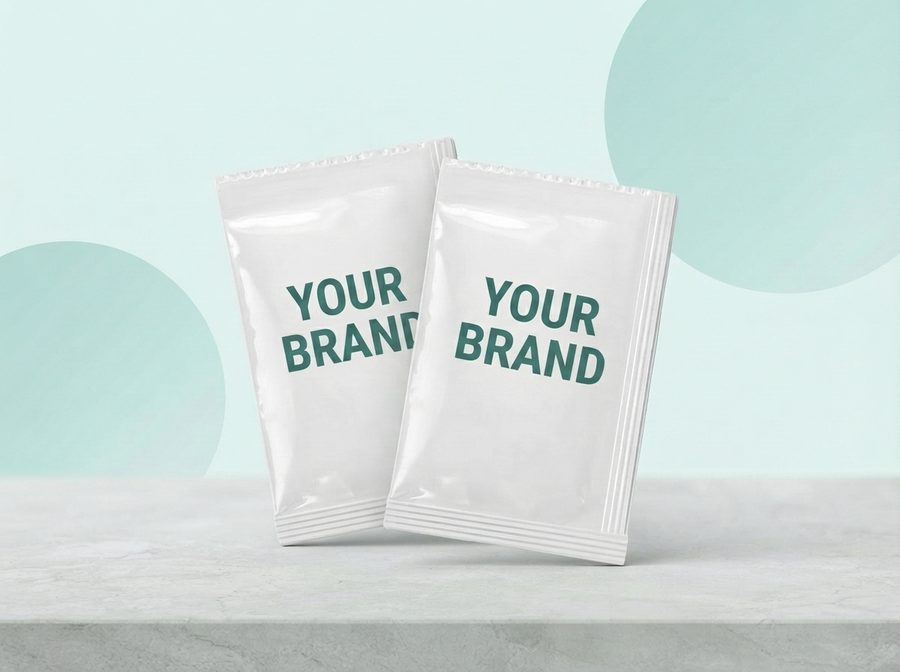
Sachets with a placeholder brand, beside the other packs we fill, are shown on examples.
Can I use a ready-made powder, or must the formula be my own?
Both routes are open; which ready-made formulas fit a sachet is confirmed in our reply. More than 500 ready-made formulas are in production across our formats, and they are not listed by name on this site. Name the category, the serving and the country of sale; for a ready-made formula that fits, you then receive a sample of the existing product.
For a formula of your own, a sample is developed to your brief first. The serving is settled with the sample, and with it the number of sachets your 300 kg will fill. How each kind of order runs is set out on white label supplements and private label supplements.
Two checks some buyers of powders ask for:
- Halal. Certification is arranged for the specific product rather than for the plant as a whole; see halal supplements.
- Banned substances. Tests can be run by an accredited third-party laboratory on request, with the report in your brand's name.
Sachet, blister or tube: which pack fits my product?
The form of the dose decides: a powder goes into a sachet, a jar or a doy-pack; a tablet, capsule or softgel can be sealed in a blister; an effervescent tablet goes into a tube.
| Your dose | Pack | Minimum counted in | Read more |
|---|---|---|---|
| A powder, one serving at a time | Sachet printed for your brand | Kilograms, from 300 kg | This page |
| A powder taken by the scoop | Jar or doy-pack of 450, 900 or 1,800 g | Kilograms, from 300 kg | Examples |
| A tablet, capsule or softgel | Blister in a printed carton, 1 to 4 blisters per carton; or a bottle | Cartons and blisters; or bottles | Blister packing |
| A drink cube | Each cube sealed in a blister of its own | Set for each product | Minimum order quantity |
| An effervescent tablet | Tube of 20 tablets of 4 g | Low minimum order, by tube count | Effervescent tablets |
The blister is the pack this site is built around. If your product can be made as a tablet or capsule, a blister run with a carton printed for your brand starts from 2,000 cartons (at least 4,000 blisters), on a ready-made formula or your own, with production in 6 to 10 weeks. Each carton holds 1 to 4 blisters, and the lidding foil is printed for your brand as well. Tooling is in place for set tablet and capsule sizes, listed on blister packing; another size, or a blister of your own design, has a minimum of its own, on minimum order quantity.
Whether a powder formula can be made as a tablet or capsule depends on the formula and on the size of the serving, so ask with your enquiry.
What should an importer in Africa or the Gulf check before ordering sachets?
Four things: the label rules of the country, the documents the registration file needs, the shelf life left on arrival, and what the regulator asks about stability in the pack you will sell.
- Label rules. We lay out and print the sachet to the label rules your importer confirms. Settle them before you approve the artwork, since new text after approval means new artwork.
- Documents. A Certificate of Analysis and the specification come with every batch, and copies of the plant's certificates with their numbers are sent on request. Where the country of sale asks for documents to be legalised, legalisation is arranged as well. The plant's GMP is GMP for food supplements, not pharmaceutical GMP; where a file asks for pharmaceutical GMP, your importer confirms with the authority what it will accept. More on export documents.
- Shelf life on arrival. The standard shelf life is 24 months, stated in the product documents, and dispatch, transit and customs each use part of it. Some importing countries apply minimum remaining shelf life rules to food; check with your importer whether such a rule applies to supplements. Plan back from lead times and shelf life and storage.
- Climate and the pack. Africa and the Gulf are not one climatic zone. WHO's list of stability conditions, written for medicines and a reference rather than law for supplements, gives Nigeria and Ghana 30 °C/75% RH, which corresponds to zone IVb, and Saudi Arabia and the UAE 30 °C/65% RH, which corresponds to zone IVa; other countries are on climatic zones by country. Ghana's FDA, in its 2013 guideline for supplements, asks for the stability study to be run in the container closure system in which the product will be marketed in Ghana; if your powder moves from a jar to sachets, ask your importer whether the study must be repeated in the new pack.
This page gives no shelf life for hot, humid conditions. If your market asks for stability data, name the product, the market and the regulator in your enquiry, together with what your importer has asked for.
The manufacturing group behind HYPERPHARM already supplies many clients in Africa. Registration in the country of sale is filed by the brand owner or the importer, not by us; our part is the documents the file draws on. Market by market: Africa and Middle East.
What your product decides
Your serving, your formula and your market settle part of the order before any preference does. Each line shows what it costs in run size, time or risk.
| Your product or plan | What changes | What it costs you |
|---|---|---|
| Your serving in grams | How many sachets 300 kg fills: 300,000 g ÷ your serving, before filling losses | Run: the smaller the serving, the more sachets there are to sell within the shelf life; ask us for the count |
| A ready-made formula | A sample of the existing product, once our reply confirms the formula fits a sachet | Time: no development stage before production |
| Your own formula | A sample developed to your brief | Time: development before production. Risk: the serving, and with it the sachet count, is known only once the sample exists |
| A powder moving from a jar or doy-pack to sachets | The same powder in a different pack | Risk: where a regulator ties stability data to the pack sold, as Ghana's 2013 guideline does, ask your importer before you switch |
| A market with a minimum remaining shelf life on arrival | A latest arrival date, set by that rule | Risk: arriving with too little time left. Run: what your distributor can sell in the time that remains |
| A dose that can be made as a tablet or capsule | A blister becomes an option | Run and time of their own: see minimum order quantity and lead times |
Questions buyers ask about powder sachets
What is the minimum order for powder sachets?
From 300 kg of powder, counted by weight. Powders in jars or doy-packs and sports nutrition start from the same 300 kg; the minimum for every format is on minimum order quantity.
How many sachets does 300 kg fill?
Divide 300,000 g by your serving in grams; the result is the count before filling losses. It is arithmetic, not a fill weight; ask us for the count for your powder and serving.
How long does a sachet order take?
Production takes from 4 weeks, on a ready-made formula or your own; see lead times. The enquiry, the sample and your approval of the sample and the artwork come before production, and transport comes after it.
Can my brand be printed on the sachet?
Yes. We lay out and print the sachet to the label rules of your market, which your importer confirms. Artwork you already have can be used instead. Only the artwork version you have approved is printed.
Can I put a ready-made formula into sachets?
Name the category, the serving and the country of sale, and our reply confirms which of the ready-made formulas in production fit a sachet. For a formula of your own, a sample is developed first.
Can I see a sample before I order?
Yes. For a ready-made formula you receive a sample of the existing product; for your own, a sample is developed to your brief. The terms for the sample are given in our reply to your enquiry.
What shelf life do powder sachets carry?
24 months as standard, stated in the product documents. Dispatch, transit and customs use part of it before the goods reach the shelf, so plan the run with shelf life and storage.
What documents come with each batch?
A Certificate of Analysis and the specification. The plant is ISO 22000, GMP and HACCP certified, with tablets, capsules and powders named in the scope, and registered with the US FDA as a food facility; its GMP is for food supplements, not pharmaceutical GMP. Copies of the certificates with their numbers are sent to clients on request.
Can powder sachets be halal?
Halal certification is arranged for the specific product rather than for the plant as a whole. The halal mark goes into the artwork once your product holds its certificate.
Do you ship powder sachets to Africa and the Gulf?
Yes. Goods ship worldwide, EXW by default, with FCA or DAP on request, and the group behind HYPERPHARM already supplies many clients in Africa. Registration in the country of sale is filed by the brand owner or the importer, not by us.
Can a powder go into a blister instead?
Our blisters take tablets, capsules and softgels, and drink cubes each in a blister of their own; a loose powder goes into a sachet, a jar or a doy-pack. If your product can be made as a tablet or capsule, the blister minimum is on minimum order quantity and its production time on lead times.
Read more
Minimum order quantity · Lead times · Blister packing · Effervescent tablets · Liquid supplements · Examples · Shelf life and storage · Climatic zones by country · Export documents · Arabic and French on supplement packaging · Halal supplements · Quality and batch documents · White label supplements · Private label supplements
Ask about your sachets
Tell us the powder (a ready-made formula or your own), the serving in grams, the quantity in kilograms, the country of sale and the pack you have in mind. We reply within 24 hours, Monday to Friday.
If your product can be made as a tablet or capsule, a blister run starts from 2,000 cartons printed for your brand (at least 4,000 blisters), with production in 6 to 10 weeks; each carton holds 1 to 4 blisters.
Request a quote → Email sales@hyperpharm.eu